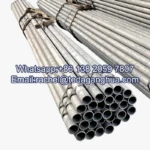
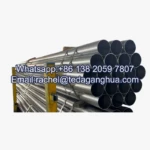
- Descripción
Descripción
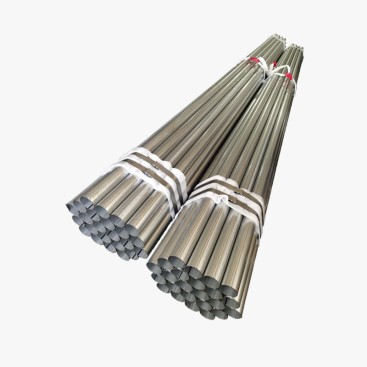
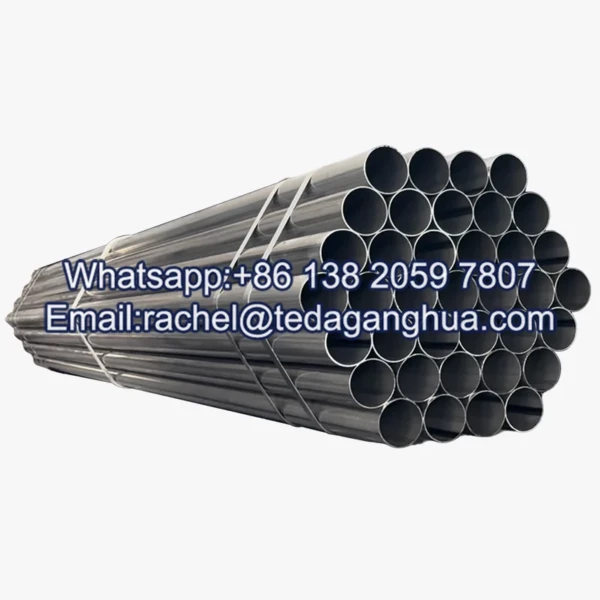
An aluminized exhaust stack pipe is designed around a different problem from a short exhaust connector: the vertical run must carry its own weight, tolerate sustained heat, manage thermal expansion, and resist moisture from rain or internal condensation. For a practical stack system, material specification should therefore cover not only outside diameter and wall thickness, but also coating type, cut length, welded joints, flanges, supports, insulation, and roof penetration details. Aluminized steel is available in both Type 1 y tipo 2 formularios, with the coating system selected according to the required corrosion and temperature performance.
Vertical Stack Pipe: Why the Geometry Matters
A horizontal exhaust section is usually supported at several points and may have relatively short unsupported lengths. A vertical stack is different. Each upper section transfers its weight downward, while wind loads, thermal movement, vibración, and connection loads are introduced through the support system. The design therefore needs controlled section lengths and properly positioned hangers or brackets rather than treating the pipe as a simple straight tube.
Typical vertical-run load path: roof or structural support → hanger/bracket → flange or reinforced connection → pipe sections → lower support. The lowest connection should not automatically be assumed to carry the entire stack; support spacing and expansion allowance should be engineered for the actual height, temperatura, wind exposure, and pipe weight.
Three Conditions That Drive Material Selection
| Condition | What the Pipe Must Handle | Procurement Focus |
|---|---|---|
| Self-weight | Continuous downward load from stacked sections and fittings | Grosor de la pared, section length, support spacing and connection strength |
| Sustained heat | Repeated thermal cycling and expansion/contraction | Base steel, coating system, operating temperature and expansion allowance |
| Rain and condensation | External wetting and potentially corrosive condensate on the internal surface | Coating coverage, drainage, joint design and condensation control |
Why Aluminized Steel Works for Exhaust Stack Service
The main advantage of an aluminum-silicon coated steel construction is that the steel substrate provides structural strength while the metallic coating provides a protective surface. Hot-dip coating forms a protective metallic layer around the steel substrate, helping separate the underlying steel from the surrounding environment.
For exhaust applications, this creates a useful two-sided protection concept. On the inside, the coating can help resist corrosion associated with moisture and condensate. On the afuera, it provides protection against atmospheric exposure and oxidation at elevated temperature. Cleveland-Cliffs, for example, lists aluminized Type 1 y tipo 2 products as dedicated coated-steel product categories and provides separate fabrication and durability information for these systems.
Internal wall
Prioritize coating continuity, welded-joint treatment and condensate management where acidic moisture can remain inside the stack.
External wall
Prioritize atmospheric corrosion resistance, thermal exposure, handling damage and protection around brackets or clamps.
Important: coating selection should not be treated as a universal temperature rating. Actual exhaust temperature, composición del gas, duty cycle, condensate chemistry and fabrication method should be checked before selecting the coating grade.
Common Stack Dimensions: 2–8 Inch Outside Diameter
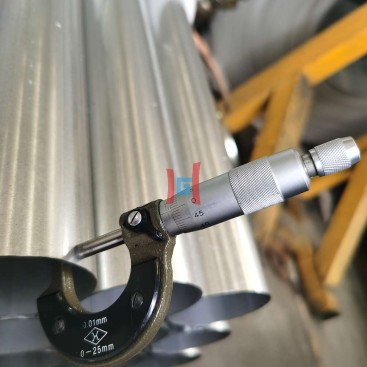
For compact industrial, calefacción, combustion and exhaust installations, a practical specification range can be built around 2–8 inch outside diameter, with approximately 1.5–3.0 mm wall thickness. These figures should be treated as a procurement range rather than a universal design rule: taller stacks, higher wind loads, larger unsupported spans or heavier fittings may require a different wall thickness.
| Diámetro externo | Typical Wall Range | Typical Application Consideration |
|---|---|---|
| 2 en | 1.5–2,0 milímetros | Small exhaust and vent runs |
| 3–4 in | 1.5–2,5 milímetros | Heating and equipment exhaust systems |
| 5–6 in | 2.0–3,0 milímetros | Longer vertical runs and higher flow rates |
| 7–8 in | 2.0–3,0 milímetros | Higher-capacity exhaust and stack sections |
For ordering, specify outside diameter × wall thickness × cut length × coating designation × base steel grade. A complete specification prevents a supplier from interpreting “2-inch exhaust pipe” as only a nominal size without knowing the actual wall and coating requirements.
Cut Lengths for Vertical Installation
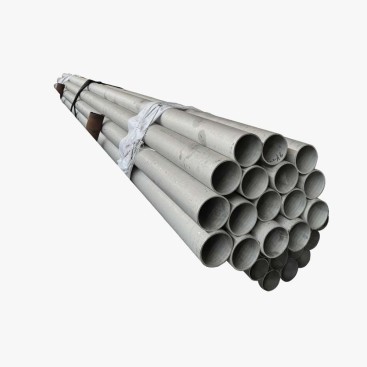
Fixed-length sections are particularly useful for stack fabrication because they simplify alignment, lifting and installation. Instead of ordering one extremely long tube, the stack can be divided into manageable sections with predetermined joint positions.
| Requirement | Recommended Specification |
|---|---|
| Diámetro | Actual OD in inch or metric dimension |
| Muro | 1.5–3,0 milímetros, subject to structural design |
| Section length | Fixed cut length according to installation height and lifting limitations |
| End preparation | Plain end, weld preparation, flange-ready or specified connection geometry |
| Superficie | Aluminized surface with coating requirements stated on the purchase order |
Fabricación: Butt Welding, Flanges and Hangers
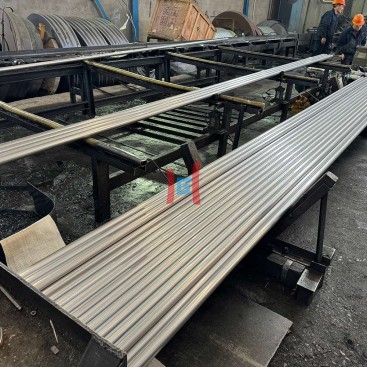
Butt welding is suitable when a continuous vertical run is required. The welding procedure must account for the coated surface because cutting and welding can locally alter or remove the coating. The joint area should therefore receive an appropriate post-fabrication protection treatment specified by the fabricator.
Bridas are useful where the stack needs to be assembled, inspected or removed in sections. Flange dimensions, bolt pattern, gasket selection and joint temperature should be specified together rather than ordering the pipe and flange as unrelated components.
Hangers and brackets should transfer the vertical load to the building or structural frame without concentrating excessive stress on the thin tube wall. Clamps should also allow for the thermal movement expected during heating and cooling cycles.
Fabrication checklist: butt-welded sections + flange connection + hanger/bracket locations + thermal expansion allowance + coating repair at fabricated areas + dimensional inspection.
Insulation and Roof Penetration
Insulation is not simply an external accessory. It can change the temperature distribution through the stack, reduce heat loss, influence condensation behavior, and protect nearby building materials from excessive surface temperature.
At a roof penetration, the stack should pass through a properly designed sleeve or penetration assembly. The sleeve should maintain the required clearance from combustible construction, while flashing and weather sealing prevent rainwater from entering the roof system. The stack itself should not be rigidly locked to the roof in a way that prevents normal thermal movement.
| Componente | Main Function | Specification Point |
|---|---|---|
| Insulation | Reduce heat transfer and surface temperature | Espesor, temperature rating and installation method |
| Roof sleeve | Provide controlled clearance at penetration | Diámetro, clearance and structural attachment |
| Flashing | Prevent rainwater intrusion | Roof type and weather-sealing method |
| Hanger/bracket | Carry vertical and lateral loads | Load capacity, spacing and thermal movement |
How to Specify an Aluminized Exhaust Stack Pipe
A useful RFQ should contain enough information for the supplier to distinguish a material quotation from a complete fabricated-stack quotation. ASTM A463, for example, covers aluminum-coated steel sheet in coils and cut lengths and defines coating systems and related testing; when the final product is a fabricated tube, the tube dimensions and fabrication requirements still need to be specified separately.
RFQ example:
DE: 4 in → Wall: 2.0 mm → Cut length: 3,000 mm → Aluminized coating: specified grade/designation → Base steel: specified grade → Joint: butt weld → Connection: flanged ends → Hangers: required → Insulation: required → Roof sleeve: required → Quantity: specified.
For procurement teams comparing suppliers, it is also useful to request the coating designation, base-steel grade, tolerancia dimensional, weld procedure, coating condition after fabrication, inspection documents and packaging method. This avoids comparing nominal pipe dimensions while overlooking differences in the finished assembly.
Teda Ganghua Supply and Fabrication Support
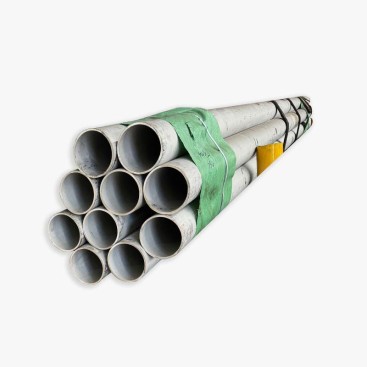
Teda Ganghua can support projects requiring tubos de acero aluminizado with specified outside diameter, espesor de pared, cut length and coating requirements. For vertical exhaust projects, buyers can provide the stack height, pipe OD, espesor de pared, section length, joint method, flange requirements and hanger positions so the material and fabrication scope can be matched to the installation plan.
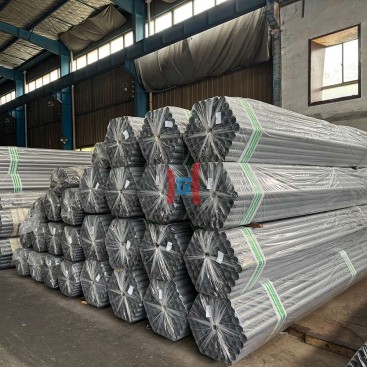
The purchasing package can be organized around stock tube supply, cut-to-length processing, welded sections and connection preparation. For projects exposed to continuous heat and condensate, the coating specification and actual service conditions should be confirmed before production rather than selecting a coating solely from the nominal pipe size.
Preguntas frecuentes
1. What diameter is commonly used for a vertical exhaust stack?
A practical project range is approximately 2–8 inches OD, but the final diameter depends on exhaust flow, allowable velocity, pérdida de presión, equipment outlet size and local installation requirements.
2. Es 1.5 mm wall thickness enough for a vertical stack?
It can be suitable for some smaller systems, but wall thickness should not be selected from diameter alone. Stack height, unsupported length, wind loading, vibración, connection loads and thermal cycling can all change the required thickness.
3. Why is condensation important in an exhaust stack?
When exhaust gases cool below their dew point, moisture can form on the internal wall. Dependiendo de la química del combustible y del escape, el condensado puede ser corrosivo. Drenaje, temperatura de funcionamiento, Por lo tanto, la selección del aislamiento y del material/revestimiento debe considerarse conjuntamente..
4. ¿Se puede suministrar la tubería con bridas y longitudes de corte fijas??
Sí. Una solicitud de cotización de proyecto puede especificar longitudes de sección fijas, uniones soldadas a tope, dimensiones de la brida, preparación de los extremos y ubicaciones de los colgadores para que las secciones suministradas estén preparadas para el montaje en el sitio.