Prix des tuyaux en acier aluminisé par tonne

- Description
Description
Comparing aluminized steel pipe price per ton requires more than checking the quoted rate. For bulk procurement, the final cost depends on how the material is weighed, whether the quotation includes taxes and packaging, the delivery point, pipe dimensions, exigences en matière de revêtement, and order volume. Two suppliers can quote the same nominal ton price while using different measurement and delivery terms.
Before evaluating a bulk offer, buyers should confirm whether the quoted tonnage is based on actual scale weight or theoretical weight. They should also establish whether the price covers the same pipe specifications and commercial scope. These checks help procurement teams avoid discrepancies between the quoted material cost and the final payable amount.
1. What Does a Price per Ton Actually Include?
A ton-based quotation is useful for large orders, but the term “price per ton” does not define the entire transaction. The quotation should specify the weight basis, currency, tax treatment, conditionnement, and delivery conditions.
| Quotation item | Possible basis | What buyers should verify |
|---|---|---|
| Weight measurement | Actual scale weight or theoretical weight | Which method determines invoiced quantity and payment |
| Tax treatment | Tax included or excluded | Applicable tax, invoice requirements, and tax responsibility |
| Packaging | Standard bundles or specified export packaging | Whether protective materials, strapping, étiquettes, and special packing are included |
| Delivery point | Factory, warehouse, port, or named destination | Whether inland transport, port handling, and other charges are included |
| Product scope | Specified OD, épaisseur de paroi, revêtement, and length | Whether all suppliers are quoting technically equivalent products |
| Additional services | Coupe, end finishing, inspection, or documentation | Which services are included and which incur additional charges |
A quotation delivered to a port may not include every cost associated with loading, terminal handling, export documentation, or ocean freight. Confirm the named delivery point and agreed trade term rather than assuming that “delivered to port” covers all port-related expenses.
2. Actual Scale Weight vs. Theoretical Weight
One of the most important bulk-purchasing decisions is how the payable weight will be established. Actual scale weight and theoretical weight are different measurement approaches, and the quotation should clearly state which one governs settlement.
Actual scale weight
Actual weight is determined by weighing the supplied material using an agreed weighing process. Buyers should clarify whether the reported weight is net pipe weight or includes packaging, bundling materials, or other items. For large shipments, the weighing location, scale documentation, and procedure for resolving discrepancies should be agreed in advance.
Theoretical weight
Theoretical weight is calculated from the specified dimensions, material assumptions, and an agreed calculation method. It can be useful when pipes are ordered by standard dimensions and lengths, but actual product dimensions and manufacturing tolerances may cause differences between theoretical and measured weight.
For coated pipe, the parties should also define whether the weight basis accounts for the coating and how that weight is established. Do not assume that all suppliers include coating mass, conditionnement, or dimensional tolerances in the same way.
Procurement rule
Specify the weighing method, net or gross weight basis, accepted documents, and payment calculation in the purchase order. A low ton price is not comparable if the payable-weight method differs.
3. Why Thin-Wall, Small-Diameter Pipe Can Have a Higher Ton Price
A higher price per ton does not necessarily mean that a supplier charges more for the steel itself. Pipe production and processing costs are not always proportional to the finished product’s weight.
For thin-wall, small-diameter pipe, certain costs may be spread across a relatively small amount of material. Setup, formation, welding where applicable, dimensionnement, contrôle du revêtement, inspection, handling, bundling, and order administration can contribute to the cost of each ton. When these costs are allocated over a lower mass of finished product, the quoted ton price can appear comparatively high.
Other factors can reinforce this effect:
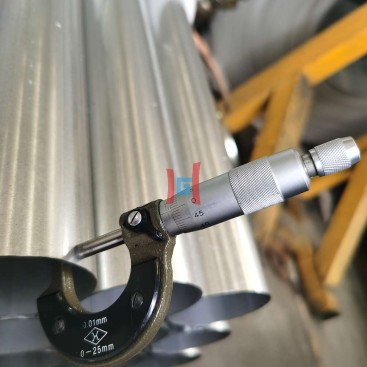
- Dimensional control: Tight wall-thickness, diamètre, straightness, or length tolerances can require additional process control and inspection.
- Cut-to-length requirements: Numerous short pieces can increase cutting, handling, and packing work compared with standard production lengths.
- Coating specifications: Specific coating requirements and verification procedures can add process-control costs.
- Small order quantities: Setup and administration costs may be distributed across fewer tons.
- Packaging and shipment efficiency: Small bundles or special packing can change the cost per ton even when the base material specification is unchanged.
Donc, compare both the ton price and the commercial scope. If the buyer needs a fixed number of meters or pieces, converting the quotation into a per-meter or per-piece cost may provide a clearer view of the actual purchasing budget.
4. Convert Ton Price, Kilogram Price, and Meter Price
Weight-based and length-based prices can be compared once the weight per meter for the exact pipe specification is established. Use a confirmed supplier weight table or an agreed calculation method, and keep the units consistent.
Ton price to kilogram price
Price per kg = Price per metric tonne ÷ 1,000
Ton price to meter price
Price per meter = (Price per metric tonne ÷ 1,000) × Weight per meter in kg
Meter price to ton price
Price per metric tonne = (Price per meter ÷ Weight per meter in kg) × 1,000
These formulas assume a metric tonne of 1,000 kg and that the price and weight use compatible product and settlement conventions. If the quotation uses a short ton or another unit, convert it before comparing rates. Currency, taxes, freight, conditionnement, and processing costs should also be normalized separately.
Weight per meter varies with outside diameter, épaisseur de paroi, matériel, and the agreed treatment of the coating. A conversion based on a different wall thickness or a different weight convention can distort the result even when the arithmetic is correct.
5. Bulk Order Tiers and Minimum Order Quantity
Bulk purchasing may offer more favorable pricing as order volume increases, but the relationship between tonnage and price is not automatic. Suppliers may have production minimums, stock availability limits, processing setup costs, or packaging requirements that influence their quotation tiers.
| Order situation | Potential pricing mechanism | What to ask the supplier |
|---|---|---|
| Below standard production minimum | Setup or small-batch costs may be allocated over fewer tons. | Is a stock option available, or is a minimum production quantity required? |
| Standard order quantity | May align with normal production, stock, or packaging arrangements. | What quantity and specification does the quoted rate cover? |
| Larger consolidated order | Production planning, material purchasing, and shipment consolidation may improve efficiency. | Is there a defined volume tier, and does it require one specification or one shipment? |
| Mixed sizes or repeated deliveries | Multiple setups, sorting, storage, or split shipments may affect the total cost. | Can quantities be combined for pricing, and are split-delivery charges applicable? |
Request the minimum order quantity and each available volume tier in writing. Also clarify whether a tier is based on total order weight, individual size, spécification du revêtement, production batch, or shipment. A larger total order does not necessarily qualify for the same rate if it contains many separate specifications or requires several deliveries.
6. How Coating, Dimensions, and Cut Length Affect Ton Pricing
Several technical variables influence the production cost and weight basis of aluminized steel pipe. They should be fixed before comparing bulk quotations.
- Coating grade and verification: State the coating type and required coating mass or thickness where applicable. Confirm the relevant product specification and inspection method instead of treating a coating designation as a temperature rating or a complete pipe standard.
- Diameter range: Different outside diameters may require different tooling, forming arrangements, handling methods, and packing configurations.
- Wall thickness: Changes in wall thickness affect material weight per meter and may also affect manufacturing and dimensional-control requirements.
- Fixed length: Standard lengths may be easier to produce and bundle. Special cut lengths can increase handling and cutting costs or create additional material waste.
- Tolerance and inspection: More demanding requirements can increase inspection frequency, documentation work, and the risk of nonconforming output.
It is also important to distinguish a coated flat-steel designation from a finished-pipe specification. If a purchase is for a finished tube or pipe, provide the pipe dimensions, construction, applicable product standard, exigences en matière de revêtement, et conditions de service. A flat-product grade alone may not define all the requirements for the finished tubular product.
7. Bulk Quotation Comparison Template
Use this table to normalize competing offers before placing a bulk order. Complete every field with supplier-confirmed information and compare quotations on the same weight, tax, and delivery basis.
| Comparison field | Supplier A | Supplier B | Required check |
|---|---|---|---|
| Outside diameter | Enter value and unit | Enter value and unit | Match the specification |
| Wall thickness and tolerance | Enter specification | Enter specification | Confirm equivalent requirements |
| Coating grade or requirement | Enter specification | Enter specification | Match coating and verification basis |
| Quoted price per ton | Enter price and currency | Enter price and currency | Normalize currency and ton unit |
| Weight settlement method | Scale / theoretical | Scale / theoretical | Confirm payable-weight basis |
| Tax and invoice basis | Included / excluded; details | Included / excluded; details | Use the same tax basis |
| Packaging and port delivery | Enter included services | Enter included services | Identify exclusions and extra charges |
| Minimum order and volume tier | Enter quantity and tier | Enter quantity and tier | Confirm qualifying volume |
| Final comparable cost | Calculate after adjustments | Calculate after adjustments | Use a common commercial scope |
When the quotation is for bulk purchasing, the most useful comparison is the total payable cost for the agreed quantity and delivery scope, alongside the normalized price per ton. This reveals whether an apparent discount remains advantageous after accounting for weight settlement, traitement, conditionnement, taxes, and delivery.
8. Prepare a Complete Bulk Inquiry
To obtain a comparable bulk quotation, provide the outside diameter, épaisseur de paroi, qualité du matériau, exigence de revêtement, norme applicable, required lengths, total tonnage, et destination de livraison. Specify whether actual scale weight or theoretical weight will govern payment, and list any tax, conditionnement, inspection, or port-delivery requirements.
Teda Ganghua works with procurement teams evaluating tubes en acier aluminisé against defined product and delivery requirements. A complete inquiry makes it easier to review the weight basis, spécification du revêtement, volume tiers, and processing scope before comparing the final commercial offers.
Foire aux questions
Is the price per ton based on actual or theoretical weight?
It depends on the supplier’s quotation and the agreed purchase terms. Confirm the weighing method, net or gross weight basis, supporting documents, and the method used to settle the invoice before ordering.
Why might thin-wall pipe have a higher price per ton?
Manufacturing setup, dimensional control, inspection, coupe, handling, and packaging costs may be spread over a smaller amount of finished material. The ton price can therefore be higher even when the product uses less material per meter.
How do I convert a ton price into a price per meter?
Divide the metric-ton price by 1,000 to obtain the price per kilogram, then multiply by the confirmed weight per meter in kilograms. The calculation is valid only when the weight basis and product specification are consistent.
Does ordering more tons always reduce the unit price?
Non. Larger orders may improve production and shipment efficiency, but the result depends on the supplier’s minimum quantities, product mix, exigences en matière de revêtement, besoins de traitement, and delivery schedule. Request written volume tiers for the exact order configuration.
What should a bulk quotation include?
It should identify the pipe dimensions, spécification du revêtement, qualité du matériau, norme applicable, ton price and currency, weight settlement method, tax treatment, conditionnement, delivery point, minimum order quantity, and any extra processing or inspection charges.