

- 説明
説明
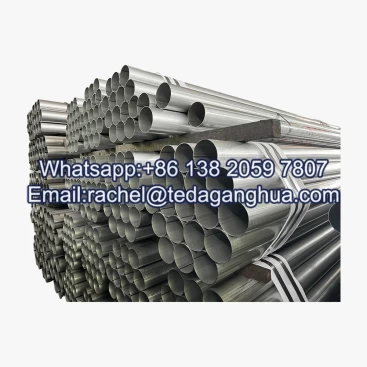
DC54D aluminized pipe uses an ultra-deep-drawing steel base for applications where tube forming places greater demands on elongation, drawability, and resistance to cracking. Compared with conventional deep-drawing grades, the DC54D level is intended for more severe forming operations, making it relevant to bent tubes, drawn sections, and other complex-shaped components. For procurement, the key is to evaluate the base steel grade and aluminized coating together rather than selecting the coating alone.
Procurement takeaway: When a tube requires repeated bending, 描画, flattening, or other severe deformation, an ultra-deep-drawing base can reduce forming risk. The coating specification should then be selected according to forming severity, 腐食にさらされる, 温度, and the required surface protection after processing.
What Is DC54D Aluminized Pipe?
DC54D is positioned in the higher-formability range of coated sheet steel grades and is intended for demanding forming applications. In an aluminized pipe, the steel substrate provides the mechanical and forming foundation, while the aluminum-silicon coating provides oxidation and corrosion protection.
The important distinction is that DC54D is a base-steel grade, while the aluminized designation describes the coating system. A complete purchasing specification should therefore identify the base grade, coating type or coating mass, チューブの寸法, 表面要件, and forming requirements.
| Specification element | What procurement should confirm |
|---|---|
| ベーススチール | DC54D or an agreed equivalent grade |
| コーティング | Al-Si coating type and specified coating mass |
| Tube geometry | ラウンド, oval, 長方形, or custom section |
| Dimensions | Outside diameter, 壁の厚さ, and length tolerance |
| 形にする | Bending radius, drawing depth, flattening, expansion, or other deformation |
| Documentation | Mill test certificate, heat/batch traceability, coating information, and dimensional inspection |
DC51D to DC57D: Understanding the Deep-Drawing Grade Ladder
The DC-series naming system is useful because the number generally indicates the required level of forming performance. As the grade moves from conventional forming toward higher deep-drawing capability, procurement should not treat all DC grades as interchangeable.
| Grade level | Typical forming position | Typical procurement consideration |
|---|---|---|
| DC51D | General forming | Simple bending and conventional forming |
| DC52D | Higher forming capability | Moderate forming and more demanding profiles |
| DC53D | 深絞り加工 | Deep-drawn components and formed tube sections |
| DC54D | Ultra-deep drawing | Complex forming where cracking and wrinkling risk must be controlled |
| DC55D–DC57D | Specialized higher-formability levels | Use only when the applicable standard and mill specification require the corresponding grade |
This ladder should be treated as a sourcing guide rather than a substitute for the governing material standard. Exact grade definitions, 機械的要件, and cross-standard equivalents must be verified against the specified standard and mill certificate.
Why DC54D Matters for Forming-Heavy Pipe
Tube forming can expose steel to several deformation modes at the same time. A component may first be roll-formed or welded, then bent, flattened, expanded, flared, or drawn into a final geometry. A conventional forming grade may work for a simple bend but become unsuitable when deformation accumulates.
曲げ
For tight-radius bending, the outside wall experiences tensile deformation while the inside wall undergoes compression. A highly formable substrate can provide greater tolerance against surface cracking and localized deformation, especially when the bending geometry is demanding.
Deep Drawing
Deep drawing places substantial deformation around the flange and wall. For parts with significant drawing depth or complex transitions, the material’s elongation and drawing behavior become critical. DC54D is therefore more relevant when forming severity is the primary selection driver rather than simply choosing the lowest available material grade.
Complex Tube Geometry
楕円形, flattened, expanded, or specially shaped tubes may require several forming operations. In these applications, the substrate should be selected together with the tooling, deformation sequence, weld design, and coating requirements.
DC54D vs DX54D: Japanese and European Procurement
DC54D and DX54D are commonly compared because both occupy the high-formability end of coated-sheet grade families. しかし, buyers should not automatically treat the two designations as identical without checking the applicable standard and mill certificate.
| アイテム | DC54D | DX54D |
|---|---|---|
| Market designation | Asian/Japanese-style procurement terminology depending on the specified standard | European coated-steel designation |
| Forming position | Very high forming capability | Deep-drawing grade |
| 一般的な使用方法 | Complex formed components | Deep-drawn and complex formed parts |
| Cross-standard purchasing | Verify exact governing specification | Specify EN requirements and certificate basis |
For international purchasing, the safest approach is to specify the required mechanical properties and applicable standard instead of requesting a nominal grade conversion alone. This avoids accepting a nominally similar grade that does not provide the required forming performance.
Choosing the Aluminized Coating for Heavy Forming
High formability of the substrate does not automatically mean the coating will tolerate every forming operation without damage. Bending and drawing can generate tensile and compressive strains in the coated surface, so the coating system should be selected with the final forming sequence in mind.
| Forming requirement | Coating selection approach | Key check |
|---|---|---|
| Light bending | Standard aluminized coating can be considered | Surface appearance and bend radius |
| Repeated bending | Confirm coating adhesion and forming compatibility | Coating cracking or localized damage |
| 深絞り加工 | Use a coating system qualified for the specified deformation | Drawing depth, die radius, lubrication, coating integrity |
| Complex forming | Confirm substrate and coating as a matched forming system | Post-forming corrosion and surface protection |
For an aluminized pipe, buyers should also clarify whether the internal surface is coated. This is particularly important when the tube carries hot gases, exhaust media, or corrosive fluids. An outside-only coating should never be assumed to provide equivalent internal protection.
Typical DC54D Aluminized Pipe Specifications
Final dimensions depend on the tube-forming process, 応用, and production capability. A practical RFQ should provide the complete dimensional envelope rather than only the material designation.
| Parameter | Typical sourcing range / requirement |
|---|---|
| 基材 | DC54D ultra-deep-drawing steel |
| Tube OD | Approximately 6–60 mm for many formed tube programs; confirm project-specific capability |
| Wall thickness | Approximately 0.5–3.0 mm depending on tube size and application |
| Section | ラウンド, oval, flattened, 長方形, or custom profile |
| 長さ | Fixed length or project-specific cut length |
| コーティング | Al-Si aluminized coating with specified coating mass |
| 処理 | 曲げ, 描画, flattening, 形にする, 切断, or other specified operations |
How Procurement Teams Should Specify DC54D Pipe
A strong RFQ should connect the material designation with the actual forming process. Simply writing “DC54D aluminized pipe” may leave important variables undefined.
- Specify the applicable base-steel standard and required grade.
- State the aluminized coating system and coating mass.
- Provide outside diameter, 壁の厚さ, 長さ, and dimensional tolerances.
- Describe bending radius, drawing depth, flattening, expansion, or other forming operations.
- Clarify whether the internal tube surface also requires aluminized protection.
- Request the mill test certificate and coating information for traceability.
- Confirm whether the finished tube will be formed before or after additional fabrication operations.
Teda Ganghua Supply & Processing Support
For buyers sourcing DC54D aluminized steel pipe, Teda Ganghua can support the specification from base material and coating through finished tube requirements. The export team can review grade, の, 壁の厚さ, 長さ, coating mass, internal coating requirements, forming operations, 検査書類, and destination requirements before confirming the suitable supply route.
With stainless and metal stock resources, processing capabilities, inspection coordination, and export experience since 2006, the focus is on matching the material and tube specification to the buyer’s actual production process. For forming-heavy applications, buyers can provide the drawing or forming sequence so the material, コーティング, and dimensional requirements can be evaluated together.
FAQs About DC54D Aluminized Pipe
Is DC54D suitable for deep-drawn pipe components?
はい. DC54D is positioned for very demanding forming applications where higher drawability is required. The actual suitability should still be verified against the required forming depth, ツーリング, 曲げ半径, and applicable material specification.
Is DC54D better than DC53D for forming?
For applications requiring a higher level of deep drawing, DC54D is generally selected above DC53D in the forming-grade hierarchy. The final choice should be based on the actual forming operation rather than grade number alone.
Is DC54D the same as DX54D?
They are commonly compared as high-formability grades, but they should not be treated as automatically interchangeable. The applicable standard, 機械的要件, コーティングシステム, 規格を超えた代替品を承認する前に、工場証明書を確認する必要があります。.
アルミメッキコーティングを別途指定する必要があるか?
はい. ベース鋼種とコーティングは別の仕様要素です. RFQ では、コーティングの種類またはコーティング量を特定し、チューブの内側にも保護が必要かどうかを確認する必要があります。.
DC54D アルミメッキパイプの問い合わせにはどのような情報を含める必要がありますか?
基本グレードと標準を提供します, コーティング要件, の, 壁の厚さ, 長さ, チューブ形状, forming operations, 曲げ半径または絞り深さ, 内部コーティングの要件, 公差, 量, 検査書類, そして目的地. これにより、サプライヤーは成形の適合性を評価し、供給の実現可能性を評価するのに十分な情報が得られます。.