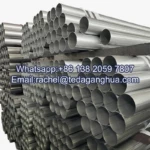
- Description
Description
When purchasing cold rolled aluminized steel tube, buyers should look beyond the nominal diameter and wall thickness. Three dimensional characteristics determine whether the finished tube can fit, connect, and perform consistently in its intended application: wall thickness tolerance, outside diameter tolerance and ovality, and straightness.
Cold-rolled substrate can provide a more consistent starting material for tube forming. More uniform strip thickness and controlled material condition help manufacturers manage these dimensions. However, cold rolling does not automatically guarantee finished-tube accuracy. Forming equipment, welding conditions, tooling, cooling, and straightening also influence the final result.
The practical point for procurement is straightforward: all three dimensions can be measured, specified, and inspected. Putting their definitions and acceptance requirements into the purchase contract is more useful than debating dimensional quality after delivery.
1. Why Dimensional Accuracy Matters for Steel Tube
A tube may meet its nominal size description and still create problems during installation or fabrication. A wall that varies too much can affect machining and forming. An inconsistent outside diameter can cause connection or assembly difficulties. Excessive straightness deviation can create alignment problems in long installations.
These issues are especially relevant when tubes are used in assemblies that require consistent fit, repeated cutting, bending, welding, or mechanical connection.
Cold-rolled substrate helps manufacturers start with a more controlled strip. Its thickness consistency and material condition can support dimensional control during forming. But the dimensions that matter to the buyer are those of the finished tube, not just the incoming steel strip.
2. Dimension One: Wall Thickness Tolerance
Wall thickness is the distance between the tube’s outer and inner surfaces, measured in the direction through the wall. Wall thickness tolerance describes the permitted difference between the actual measured thickness and the specified nominal thickness.
For example, a purchase order may state a nominal wall thickness and define an acceptable positive and negative deviation. The actual limits must be agreed according to the product specification and application; they should not be assumed from the words cold rolled.
Why Does Cold-Rolled Substrate Help?
More uniform incoming strip thickness gives the tube-forming process a more consistent starting point. This can help reduce variation in the finished wall, provided that forming, welding, and subsequent processing are also properly controlled.
However, the finished wall thickness can still be influenced by:
- Thickness variation in the incoming steel strip.
- Forming and welding process conditions.
- Local deformation around the weld seam.
- Calibration, sizing, and other downstream operations.
- Measurement position and inspection equipment.
For procurement, specify the nominal wall thickness, permitted deviation, measurement locations, and applicable inspection requirements. If the weld area is subject to a different acceptance rule, clarify that separately.
3. Dimension Two: Outside Diameter Tolerance and Ovality
Outside diameter is the distance across the external surface of a tube through its central axis. Outside diameter tolerance defines how far the actual diameter may deviate from the nominal value.
Ovality, also called out-of-roundness, describes the difference between the maximum and minimum outside diameters measured at the same cross-section.
Ovality calculation
Ovality difference = Maximum outside diameter − Minimum outside diameter
The acceptance limit and measurement procedure should be stated in the agreed product specification.
Why Does Cold-Rolled Substrate Help?
More consistent strip thickness and material condition can support more predictable forming behavior. When the strip is formed into a round section, stable material properties and controlled forming conditions help manufacturers manage dimensional variation and springback.
Nevertheless, outside diameter and ovality are finished-tube characteristics. They are also affected by roll design, forming pressure, sizing operations, welding heat input, cooling, and calibration.
Buyers should therefore specify both outside diameter tolerance and ovality where roundness is important. A tube can meet its nominal outside diameter at one measurement position while still showing an unacceptable difference between its maximum and minimum diameters at the same cross-section.
4. Dimension Three: Straightness
Straightness describes how closely a tube follows a straight reference line along its length. In practical inspection, straightness or bending deviation is evaluated by measuring the maximum distance between the tube and a defined reference line or surface over a specified length.
This requirement is important for long tubes, structural assemblies, automated feeding, and applications where several tube sections must align during installation.
Why Does Cold-Rolled Substrate Help?
A more consistent incoming strip condition can make the forming process more predictable. More uniform material properties and a controlled stress condition may help reduce variation during forming and subsequent straightening.
But straightness is not determined by the substrate alone. Forming alignment, welding heat distribution, cooling, residual stress, handling, and straightening operations all contribute to the final result.
For this reason, buyers should specify straightness as a finished-tube requirement rather than assuming that cold-rolled material will automatically produce a straight tube.
5. The Three Dimensional Requirements Compared
The following table summarizes the three dimensions that should be considered when preparing a tube inquiry. It separates the definition of each item from the influence of the substrate and the finished-product acceptance requirement.
| Dimension | Definition | How Cold-Rolled Substrate Helps | What Must Be Accepted |
|---|---|---|---|
| Wall thickness tolerance | Deviation between actual wall thickness and nominal wall thickness. | More uniform strip thickness provides a more consistent starting material. | Permitted thickness deviation and measurement locations. |
| Outside diameter tolerance and ovality | Diameter deviation and the difference between maximum and minimum outside diameters at one cross-section. | Consistent material condition can support more predictable forming and sizing. | Diameter limits, ovality limits, and measurement method. |
| Straightness | Deviation of the tube from a defined straight reference over a specified length. | More consistent substrate condition can support stable forming and straightening. | Permitted deviation, reference length, and inspection arrangement. |
6. How to Write the Three Dimensions into a Purchase Order
Each dimension should have a clear definition and an agreed acceptance requirement. Simply writing precision tube or high dimensional accuracy does not tell the manufacturer what to measure or what limits to meet.
A practical dimensional specification should include the following information:
- Wall thickness: Nominal value, permitted deviation, and measurement locations.
- Outside diameter: Nominal diameter, permitted deviation, and measurement position.
- Ovality: Maximum difference between the largest and smallest outside diameter at the same cross-section.
- Straightness: Permitted deviation over a defined reference length and the inspection method.
- Inspection basis: Applicable product standard or mutually agreed measurement and acceptance procedure.
A useful purchasing rule: These three dimensional items can all be measured, written into the contract, and checked during inspection. Defining them before production gives both buyer and supplier a clear acceptance basis.
7. Dimensional Accuracy Is Not the Same as Coating Quality
Although cold-rolled substrate can support dimensional control, it does not establish the quality of the aluminum-based coating. Buyers should keep substrate dimensions and coating acceptance requirements separate.
For an aluminized tube, the coating specification should independently identify:
- Whether the coating is pure aluminum or aluminum-silicon alloy.
- The required coating mass and whether the value represents the combined mass on both sides.
- The agreed coating adhesion test method and acceptance criteria.
- Whether the internal and external surfaces require the same coating condition.
- How the weld seam and any processed areas are treated and inspected.
The production route also matters. A tube made from pre-coated strip may have different coating conditions around the formed and welded seam from a tube coated after fabrication. Buyers should clarify the manufacturing route when coating coverage is important.
8. Dimensional Inspection: Define the Method Before Delivery
Dimensional acceptance depends on both the permitted limits and the way measurements are taken. Even when buyer and supplier agree on a nominal dimension, inconsistent measurement positions or reference lengths can lead to different inspection results.
Before production, confirm the following points:
| Inspection Item | Measurement Arrangement to Agree |
|---|---|
| Wall thickness | Measurement equipment, positions around the circumference, and treatment of the weld area. |
| Outside diameter | Measuring instrument, cross-section locations, and acceptance limits. |
| Ovality | Maximum and minimum diameter measurements at the same cross-section. |
| Straightness | Reference surface or line, measurement length, and permitted deviation. |
| Sampling | Inspection frequency, sample quantity, and lot definition under the agreed specification. |
Sampling frequency and acceptance rules should follow the applicable product standard or a written agreement between the buyer and supplier. A dimensional requirement without a defined inspection basis may be difficult to apply consistently.
9. Teda Ganghua Metal: Support for Aluminized Tube Specifications
Teda Ganghua Metal is a steel stockist based in Tianjin TEDA, with 20 years of stockist and export experience. The company supports industrial buyers with material sourcing, specification coordination, and export supply services.
For cold-rolled and aluminum-coated tube projects, Teda Ganghua Metal can help buyers clarify substrate grade, nominal dimensions, dimensional tolerances, coating requirements, and inspection arrangements before order confirmation.
Our supply coordination can include material test certificates, dimensional inspection documentation, and third-party inspection arrangements according to the agreed purchase requirements. Buyers are welcome to arrange inspections to verify the supplied material against the contract.
Explore our aluminized steel tubes product category to discuss substrate selection, tube dimensions, coating specifications, and project requirements.
Clear specifications help both sides work toward the same acceptance criteria. Rather than relying on general descriptions such as precision or high quality, Teda Ganghua Metal encourages buyers to define measurable dimensional and coating requirements before production.
Frequently Asked Questions
1. What are the three main dimensional requirements for cold-rolled steel tube?
The three important requirements are wall thickness tolerance, outside diameter tolerance and ovality, and straightness. Each describes a different aspect of finished-tube geometry and should have its own acceptance criteria.
2. How is tube ovality calculated?
Ovality is commonly expressed as the difference between the maximum and minimum outside diameters measured at the same cross-section. The applicable acceptance limit and measurement procedure should be stated in the product specification.
3. Does cold-rolled substrate guarantee accurate tube dimensions?
No. It provides a more controlled starting material, but finished dimensions also depend on forming, welding, sizing, cooling, straightening, and inspection. The finished tube must be measured against the agreed requirements.
4. Does cold rolling determine the coating mass?
No. Coating mass is a separate coating requirement. Buyers should specify the coating type, agreed coating mass, measurement basis, and adhesion testing independently of the substrate condition.
5. Should dimensional tolerances be included in the purchase contract?
Yes. Wall thickness, outside diameter, ovality, and straightness should be defined with measurable limits and an agreed inspection basis. This makes dimensional acceptance clearer before production and delivery.