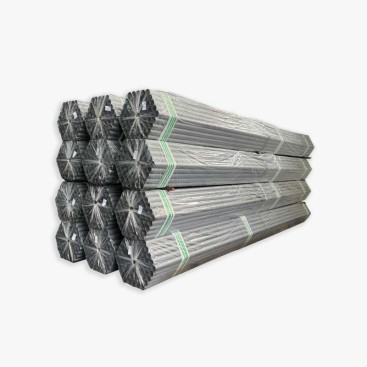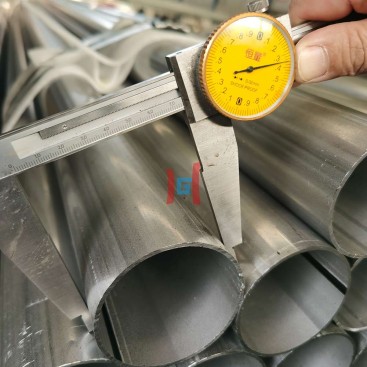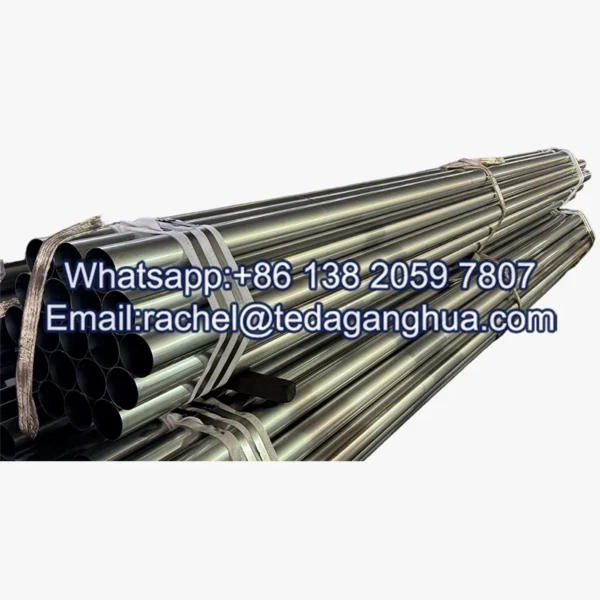


- 描述
描述
Weight per meter is useful for estimating material quantity, shipping weight and purchasing requirements, but the standard steel-pipe formula does not tell the whole story. For aluminized steel pipe, the basic calculation gives the theoretical weight of the steel substrate. The aluminum-silicon coating, actual wall-thickness variation and the agreed weighing method can all cause the delivered weight to differ from the calculated value.
For procurement managers, the safest approach is to separate theoretical steel weight, coating weight 和 actual weighed weight. This prevents a simple formula from being mistaken for the final commercial settlement weight.
The Standard Formula
For a circular steel pipe, the commonly used metric formula is:
每米重量 (kg/m) = (OD − t) × t × 0.02466
OD = outside diameter in mm | t = wall thickness in mm
The constant 0.02466 converts the circular steel cross-sectional area into an approximate mass per meter using the conventional density basis for steel. 结果是 theoretical steel-substrate weight, not automatically the final weight of a coated pipe.
Example of the calculation
Suppose a pipe has an outside diameter of 168.3 毫米 and a nominal wall thickness of 7.11 毫米:
(168.3 − 7.11) × 7.11 × 0.02466 ≈ 28.26 kg/m
This means the calculated steel substrate weight is approximately 28.26 每米公斤. It should not be interpreted as the exact scale weight of the finished aluminized product.
What the Formula Includes—and What It Misses
| 物品 | Included in Basic Formula? | Effect on Actual Weight |
|---|---|---|
| Outside diameter | 是的 | Defines the pipe geometry used in the calculation |
| Nominal wall thickness | 是的 | Determines the theoretical steel cross-section |
| Steel density assumption | 是的 | The constant represents a conventional theoretical density basis |
| 铝硅涂层 | 不 | Adds mass to the finished product |
| Actual wall-thickness variation | 不 | Can make actual mass differ from nominal theoretical weight |
| Actual coating variation | 不 | Can cause additional weight variation |
| Scale weight | 不 | Represents the physical delivered product when weighed under the agreed method |
This distinction is the central point of any weight calculation for coated tube. A theoretical value is useful for engineering and estimating, while commercial settlement may depend on actual measured weight or another contractual basis.
Why the Coating Matters
The standard formula calculates the steel body from its dimensions. It does not separately calculate the mass of the aluminum-silicon coating applied to the external and, where applicable, internal surfaces.
Aluminum-silicon coating specifications can be expressed as a coating mass per unit area, 例如 AS80 或者 AS150. The numerical designation represents coating mass according to the applicable specification system; it should not be interpreted simply as an additional percentage of pipe weight.
To estimate the coating contribution more accurately, the buyer needs the applicable coating mass, the coated surface area and the supplier’s measurement basis. The resulting calculation can then be considered separately from the steel-substrate calculation.
Do not simply add a fixed percentage
A coating should not automatically be estimated as a universal percentage of the steel weight. The actual coating contribution depends on the specified coating mass, coated surface area and production variation. A percentage adjustment may be useful for rough estimation in some products, but it is not a substitute for the applicable coating specification.
The Effect of Wall-Thickness Tolerance
Nominal wall thickness is one of the most important inputs in the formula. 然而, the physical pipe does not necessarily have exactly the nominal wall thickness at every point.
If the actual wall thickness is higher than the nominal value used for calculation, the actual steel mass will generally be higher. If it is lower, the mass will generally be lower. This is why theoretical weight and scale weight can differ even before the coating is considered.
The relationship is also nonlinear in practical terms because the wall thickness appears directly in both the steel cross-sectional calculation and the internal-diameter term represented by (OD − t) × t.
Nominal weight vs actual weight
| Weight Concept | Basis | 典型用途 |
|---|---|---|
| Theoretical steel weight | Nominal OD and nominal wall thickness | Estimation, quotation preparation, loading calculations |
| Estimated coated weight | Steel weight plus estimated coating contribution | Planning and logistics estimation |
| Actual weight | Physical product measured by an agreed weighing method | Delivery verification or contractual settlement |
A Reusable OD × Wall Thickness Weight Table
The following template can be reused for customer enquiries, production planning or internal quotation work. The numerical cells are intentionally left blank so that the table can be populated from the customer’s actual specifications.
| Outside Diameter OD (毫米) | Wall Thickness t (毫米) | Theoretical Steel Weight (kg/m) | Coating Contribution | Estimated Finished Weight (kg/m) |
|---|---|---|---|---|
| ________ | ________ | ________ | ________ | ________ |
| ________ | ________ | ________ | ________ | ________ |
| ________ | ________ | ________ | ________ | ________ |
| ________ | ________ | ________ | ________ | ________ |
| ________ | ________ | ________ | ________ | ________ |
Calculation instruction: enter OD and wall thickness in millimeters, calculate the theoretical steel weight using (OD − t) × t × 0.02466, then determine whether a separate coating-weight calculation is required.
How to Account for Coating Weight
When the coating specification gives a mass per unit area, the coating contribution can be estimated from the relevant coated surface area. The exact calculation should follow the applicable product specification because coating definitions can differ in terms of whether the stated mass refers to one side, both sides, nominal mass or a test-based value.
For a simplified planning calculation, the logic is:
Estimated finished weight
≈ theoretical steel weight + estimated coating weight
The result should be labeled as an estimate unless the coating mass and calculation basis are contractually defined. For a commercial settlement, the supplier and buyer should agree whether coating weight is included in the stated theoretical mass or handled separately.
Metric and Imperial Weight Calculations
When customers work in imperial dimensions, a commonly used comparison formula is:
Weight per foot (lb/ft) = 10.69 × (OD − t) × t
OD and t are expressed in inches for this form of the equation.
Do not mix millimeter dimensions with the imperial constant. The units used for OD, wall thickness and the formula constant must remain consistent.
Why Theoretical Weight and Scale Weight Differ
Three factors are particularly important when comparing a calculated value with the physical weight of delivered coated pipe.
1. 涂层质量
The basic steel formula does not include the aluminum-silicon coating. Even when the steel dimensions are exactly as specified, the finished coated product will contain additional material.
2. Wall-Thickness Variation
The calculation normally uses nominal wall thickness. Actual production thickness can vary within the permitted manufacturing tolerance. Because wall thickness directly affects the cross-sectional steel area, this variation changes the actual mass per meter.
3. Weighing and Settlement Method
A scale measures the physical product presented to it under the agreed weighing conditions. A theoretical calculation, by contrast, is derived from nominal dimensions. These two values should not be treated as interchangeable unless the contract specifically defines them that way.
The commercial point procurement teams should not miss
Always specify whether settlement is based on theoretical weight or actual weighed weight. If the contract does not define the basis clearly, differences caused by dimensional tolerance and coating mass can become a quantity or payment dispute.
Theoretical Weight vs Actual Weighed Weight in a Purchase Contract
| Contract Item | Should Be Defined | Potential Dispute If Unclear |
|---|---|---|
| Weight basis | Theoretical or actual | Different invoice quantity or settlement weight |
| 壁厚 | Nominal size and applicable tolerance | Calculated weight differs from scale weight |
| 涂层 | Coating grade and mass basis | Finished weight differs from bare-steel calculation |
| Measurement method | Scale, tare and weighing procedure | Buyer and seller obtain different measured quantities |
| Length basis | Nominal or actual finished length | Piece count and total-weight calculations diverge |
Weight Calculation Workflow for Procurement
步 1 — Confirm OD.
Record the specified outside diameter in millimeters.
步 2 — Confirm wall thickness.
Use the nominal wall thickness for the theoretical calculation and record the applicable tolerance separately.
步 3 — Calculate steel weight.
Apply (OD − t) × t × 0.02466 to obtain the theoretical steel-substrate weight per meter.
步 4 — Check coating specification.
Determine whether the coating mass needs to be added separately for the intended calculation.
步 5 — Estimate total material weight.
Combine the theoretical steel weight and applicable coating contribution when an estimated finished weight is required.
步 6 — Compare with actual production data.
Use actual measured dimensions and scale weight where the purchase specification requires physical verification.
步 7 — Confirm settlement terms.
State clearly whether the commercial transaction uses theoretical weight, actual weighed weight, or another agreed basis.
How Teda Ganghua Can Support Weight and Specification Confirmation
For procurement managers sourcing coated steel tube, Teda Ganghua can provide the dimensional information required for theoretical weight calculations, including outside diameter, 壁厚, length and applicable coating specifications. The calculation can then be compared with production and shipment information according to the agreed purchasing basis.
For enquiries involving 渗铝钢管, buyers can provide their complete OD × wall-thickness combination, required lengths, 数量, coating requirement and destination. This makes it possible to discuss theoretical weight, estimated finished weight, packaging and shipment planning as one specification rather than treating weight as an isolated number.
For commercial orders, the final settlement method should be confirmed before production. If actual weighed weight is required, the applicable weighing procedure and documentation should also be agreed in advance.
The Bottom Line
The formula for steel pipe weight per meter is straightforward: (OD − t) × t × 0.02466, with OD and t in millimeters. The difficult part is understanding what that number represents.
It represents the theoretical weight of the steel substrate based on nominal dimensions. It does not automatically include the aluminum-silicon coating, production variation in wall thickness, or the physical result recorded by a weighing scale.
For purchasing, the most reliable specification therefore separates three values: theoretical steel weight, estimated coated weight and actual weighed weight. Once the coating basis, dimensional tolerance and settlement method are written into the contract, the risk of weight-related disputes becomes much easier to control.
常见问题
How do I calculate steel pipe weight per meter?
For a circular steel pipe, use 重量 (kg/m) = (OD − t) × t × 0.02466, with outside diameter and wall thickness in millimeters. The result is the theoretical steel-substrate weight.
Does the standard pipe-weight formula include the aluminized coating?
不. The basic formula calculates the theoretical steel body from nominal dimensions. The coating contribution needs to be evaluated separately according to the applicable coating specification and mass basis.
Why is actual pipe weight different from theoretical weight?
The main reasons include wall-thickness variation, coating mass and production tolerances. The theoretical calculation uses nominal dimensions, while a scale measures the physical finished product.
Should pipe weight be settled by theoretical or actual weight?
Either basis can be used if it is clearly agreed in the purchase contract. The contract should specify the weight basis, dimensional assumptions, coating treatment and weighing procedure so that both parties use the same method.
Can coating weight be estimated as a fixed percentage of steel weight?
A fixed percentage can provide a rough planning estimate in some situations, but it should not replace the actual coating specification. A more reliable estimate uses the specified coating mass and the relevant coated surface area.