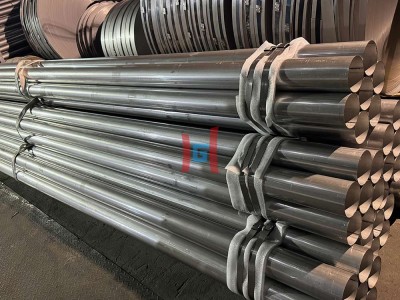
Heat Treatment of Cold-Rolled Precision Bright Steel Pipes
Heat treatment is a key step in manufacturing mechanical parts, tools, and molds. It improves strength, wear resistance, corrosion resistance, and workability. Several types of heat treatment are used depending on the desired properties.
1. Annealing
During annealing, the steel pipe is heated to a certain temperature. It is then held for a period based on the material and size, and cooled slowly.
Purpose:
To improve structure stability
To increase workability
To prepare for later processes like quenching
2. Normalizing
In normalizing, the pipe is heated and cooled in air.
Compared to annealing:
The structure becomes finer
Cutting performance is improved
It is often used as the final treatment for parts with lower performance needs.
3. Quenching
Quenching involves heating and then rapidly cooling the pipe in water, oil, or other liquids.
Result:
Hardness is increased
Brittleness also increases
4. Tempering
Tempering is done after quenching. The steel pipe is heated to a lower temperature (below 650°C), held for some time, then cooled.
Purpose:
To reduce brittleness
To maintain hardness
5. The “Four Fires” of Heat Treatment
Annealing, normalizing, quenching, and tempering are called the “four fires.”
Quenching and tempering are often used together
These processes are essential for most heat-treated parts
6. Quenching and Tempering
When quenching is followed by high-temperature tempering, it is called quenching and tempering.
Effect:
A good balance of strength and toughness is achieved
7. Aging Treatment
After quenching, some alloys are left at room or slightly higher temperatures for a long time.
Purpose:
To increase hardness, strength, or magnetic/electrical properties
This is known as aging treatment.
8. Deformation Heat Treatment
Deformation heat treatment combines heat treatment and pressure deformation.
Benefit:
Strength and toughness are improved
9. Vacuum Heat Treatment
This process is done in a vacuum or low-pressure atmosphere.
Advantages:
Oxidation and decarburization are avoided
The surface remains smooth
Chemical heat treatment can be combined during this process
10. Surface Heat Treatment
Only the surface of the pipe is heated.
Goal:
To improve surface hardness without affecting the core
Common methods:
Flame quenching
Induction heating
Heat sources:
Oxyacetylene, lasers, electron beams, and induction current
11. Chemical Heat Treatment
This process changes the surface composition of the pipe by adding elements like carbon, nitrogen, or chromium.
Steps:
The pipe is heated in gas, liquid, or solid mediums containing desired elements
The elements penetrate the surface
Further heat treatments like quenching or tempering may follow
Main types:
Carburizing
Nitriding
Metallizing
12. Importance of Heat Treatment
Heat treatment plays a vital role in improving the performance of steel parts.
Examples:
White cast iron becomes forgeable after annealing
Gear lifespan can be greatly extended by proper heat treatment
Low-cost carbon steel can gain properties similar to alloy steel through chemical heat treatment
Almost all tools and molds require heat treatment before use