- 説明
説明
Aluminized steel pipe is often quoted per metre when the buyer purchases cut lengths, finished tube sections, or components for field installation. The conversion is straightforward in principle: calculate the theoretical mass per metre from outside diameter and wall thickness, multiply it by the applicable material basis, then add coating, tube-making, cutting and other processing costs. The important point is to establish whether the quoted per-metre figure is based on theoretical weight, actual scale weight, or a finished-piece calculation.
Why Buyers Use a Per-Metre Basis
Per-metre costing is particularly practical when the final product is installed or fabricated by length rather than purchased by total tonnage. A contractor may need a specific number of 2 メートル, 3 m or 6 m sections, while a fabrication shop may calculate its material requirement from the length of each exhaust or duct section.
A per-metre basis makes it easier to calculate the material portion of each fixed-length piece.
Installers can compare material consumption directly with the required installed length.
Finished component costs can be built from length, cutting and forming requirements.
しかし, “per metre” is only a commercial unit. It does not explain how the number was calculated. Two suppliers can quote different metre values while both are mathematically correct if they use different substrate grades, 塗装仕様, weight conventions, processing charges or delivery terms.
The Basic Weight-to-Length Conversion
For a round steel tube, the theoretical mass per metre can be estimated from the steel density and the cross-sectional area of the annulus. Using millimetres for outside diameter and wall thickness, a commonly used approximation for carbon steel is:
m ≈ 0.02466 × t × (D − t)
m = theoretical steel mass in kg/m
D = outside diameter in mm
t = wall thickness in mm
The formula calculates the steel substrate portion using a standard theoretical density. For a coated product, the actual finished mass can be somewhat different because the coating adds material and the finished tube may also have dimensional and manufacturing tolerances.
The commercial conversion can then be represented as:
Price per metre ≈ metre weight × material cost per kg + コーティング + processing
Processing may include tube forming, 溶接, 切断, end treatment, 曲げ, inspection and other specified services.
If the supplier quotes material by tonne, convert the tonne basis to kilograms before multiplying by the theoretical mass per metre. The quotation should also clarify whether the coating is already incorporated into the stated weight basis.
例: Converting a Tube Specification to Metre Weight
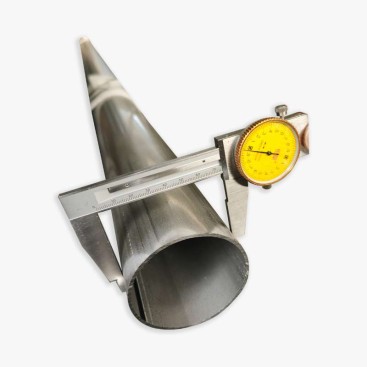
Consider a round tube with an outside diameter of 50.8 mm and a wall thickness of 1.5 mm. The theoretical substrate weight is approximately:
D: 50.8 mm
t: 1.5 mm
Theoretical steel weight: 0.02466 × 1.5 × (50.8 − 1.5) ≈ 1.82 kg/m
6 m theoretical substrate weight: 約 10.9 kg before considering coating and manufacturing tolerances.
This is a weight calculation rather than a quotation. To obtain the commercial metre figure, the buyer still needs the applicable substrate basis, 塗装仕様, processing requirements and delivery terms.
Reference Theoretical Weights by Size
| 外径 | 壁の厚さ | 約. Steel Weight | 約. 6 m Substrate Weight |
|---|---|---|---|
| 25.4 mm | 1.5 mm | 0.88 kg/m | 5.28 kg |
| 38.1 mm | 1.5 mm | 1.35 kg/m | 8.10 kg |
| 50.8 mm | 1.5 mm | 1.82 kg/m | 10.92 kg |
| 60.0 mm | 2.0 mm | 2.86 kg/m | 17.16 kg |
| 76.1 mm | 2.0 mm | 3.66 kg/m | 21.96 kg |
| 101.6 mm | 2.5 mm | 6.11 kg/m | 36.66 kg |
These figures are theoretical substrate weights calculated from the dimensional formula and should not be treated as certified finished-product weights. 塗布量, actual dimensions, density assumptions and manufacturing tolerances can change the final measured mass.
What Changes the Cost per Metre?
Outside Diameter and Wall Thickness
These two dimensions directly control material consumption. Increasing wall thickness generally produces a larger increase in kg/m because the cross-sectional steel area becomes greater. A larger diameter also increases the amount of material required for each metre when the wall thickness remains constant.
For this reason, comparing two metre quotations without comparing OD and wall thickness can produce a misleading conclusion. The dimensional basis must be identical before the commercial figures can be compared.
Fixed Length
Fixed-length requirements can introduce cutting loss. A standard production length may not divide evenly into the required finished lengths, leaving remnants. 例えば, an order requiring many short sections can have a different material yield from an order using the same tube in longer sections.
The quotation should state whether cutting loss is incorporated into the per-metre calculation or charged separately.
End Treatment
Plain-cut ends normally require less processing than beveled, deburred, expanded, swaged, flared or otherwise formed ends. If the pipe is supplied as a finished component, end treatment can become a separate processing line in the quotation.
Batch Size
Small production batches may carry a larger setup component per metre because preparation and inspection activities are spread over fewer pieces. Larger compatible orders can distribute certain fixed production costs over more metres and may also improve packing and freight utilization.
The Coating Weight Question
One common mistake is assuming that the theoretical steel weight is automatically the finished coated weight. It is not. A coating adds mass to the substrate, although the exact contribution depends on the coating designation, coating mass, dimensional surface area and the method used to express the coating requirement.
For aluminum-coated steel products, the applicable specification should be checked for whether coating mass is stated as a total of both surfaces, per surface, or under another defined convention. ASTM A463/A463M, for example, defines coating designations and coating-mass requirements for aluminum-coated steel sheet. ([store.astm.org](https://store.astm.org/a0463_a0463m-22.html?utm_source=chatgpt.com))
Procurement check: Ask whether the quoted metre weight represents the theoretical substrate, theoretical finished tube, or actual measured product. If the coating is excluded from the calculation, make sure this is clearly stated.
Theoretical Weight vs Actual Weighing
A quotation may use one of two common settlement methods: theoretical weight または actual scale weight. Neither should be assumed from a per-metre unit alone.
| Settlement Basis | How It Works | What Buyer Should Confirm |
|---|---|---|
| Theoretical weight | Uses specified dimensions and a defined density/formula | Formula, density, tolerances and coating treatment |
| Actual weight | Uses the measured weight of the supplied goods | Scale basis, weighing point and acceptable variance |
| Piece basis | Finished pieces are priced according to agreed dimensions and processing | Finished length, 許容範囲, processing and piece count |
The difference becomes particularly important for international procurement. A buyer may compare one supplier’s theoretical kg/m calculation with another supplier’s actual-weight settlement and mistakenly assume the underlying material specifications are different.
Who Pays for Short-Length Cutting Loss?
Short-length loss should be addressed before the order is confirmed. If the supplier cuts standard stock into shorter sections, the unused remainder may be treated in several ways: included in the supplier’s yield calculation, charged through a cutting allowance, retained by the supplier, or assigned to the buyer according to the agreed commercial terms.
Do not leave this issue implicit when the order contains large quantities of short pieces. A small difference in yield per stock length can become material across a production run.
Ask: What standard stock length will be used?
Ask: How many finished pieces can be cut from each stock length?
Ask: Who owns usable remnants?
Ask: Is cutting loss included in the quoted metre basis?
What a Per-Metre Quotation Should State
A professional quotation should make the commercial calculation reproducible. 少なくとも, request the following information:
| Quotation Field | Required Information |
|---|---|
| Unit | USD/m, EUR/m, RMB/m or another agreed currency per metre |
| Product dimensions | Outside diameter × wall thickness × length |
| Weight basis | Theoretical, actual scale weight or finished-piece basis |
| コーティング | コーティングの種類, standard and coating mass/designation |
| 処理 | 切断, deburring, 曲げ, end treatment and inspection |
| Freight | Included or excluded; delivery basis and destination |
| Cutting loss | Included, separately charged or allocated to buyer |
Teda Ganghua Per-Metre Sourcing Support
泰達江華 can help procurement teams build a comparable quotation around the actual tube specification rather than a single unexplained unit figure. Buyers can provide OD, 壁の厚さ, コーティング要件, fixed length, quantity and processing requirements, allowing the material and conversion requirements to be evaluated together.
For buyers sourcing アルミメッキ鋼管, Teda Ganghua can coordinate stock and customized requirements, including cut-to-length specifications where applicable. For a per-metre quotation, buyers can request the theoretical weight, coating basis, processing charge, cutting arrangement and logistics component separately so that the final figure can be checked against the physical specification.
The most reliable comparison is therefore not simply the lowest number per metre. It is a like-for-like calculation based on the same OD, 壁の厚さ, substrate, コーティング, 長さ, 許容範囲, processing, weight settlement method and delivery basis.
よくある質問
How is the theoretical weight per metre calculated?
For a round steel tube, a commonly used approximation is m ≈ 0.02466 × t × (D − t), where D is outside diameter in millimetres and t is wall thickness in millimetres. The result is the theoretical steel substrate weight in kilograms per metre.
Does the theoretical weight include the aluminum coating?
自動的ではありません. The basic formula calculates the steel substrate using a standard density assumption. The quotation should state whether coating mass has been incorporated into the finished weight or handled separately.
Why can two suppliers quote different figures per metre?
The suppliers may be using different substrate grades, 壁の厚さ, 塗装仕様, processing charges, cutting yields, batch quantities or settlement methods. They may also quote different delivery bases. Comparing the complete specification is necessary before interpreting the difference.
Should freight be included in the metre figure?
Either approach can be used commercially, but the quotation should state it clearly. For international orders, メートルあたりの数値が工場出荷時の数値であるかどうかを指定する, FOB, CIF, DDP またはその他の合意された配信基準により、さまざまなオファーを一貫して比較できます.
メートル単位の見積もりをリクエストする最良の方法は何ですか??
外径を明記してください, 壁の厚さ, 基板グレード, コーティングの種類と質量, fixed length, 量, 処理要件と宛先. 次に、サプライヤーに単位ベースを特定するように依頼します。, 理論的または実際の重量法, カットロス処理, 手数料と運賃が含まれるかどうか.