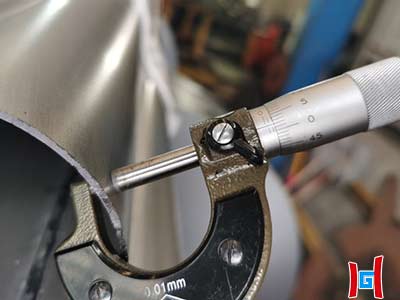
r90 против n90 при глубокой вытяжке листового металла
r90 и n90 — два параметра материала, которые могут незаметно определить, выживет ли лист глубокой вытяжки при формовании.. They are not thickness values, strength grades, or surface-finish codes. Вместо, they describe how sheet metal deforms during tensile loading: r90 reflects directional plastic anisotropy, пока n90 reflects strain-hardening behavior. For procurement engineers, understanding the difference helps explain why two sheets with the same grade, толщина, and tensile strength can behave very differently in a deep-drawing operation.
Remember it this way: r90 mainly tells you how evenly the sheet deforms in different directions; n90 tells you how strongly the material hardens as it is stretched. In deep drawing, r90 is closely related to directional behavior and earing, while n90 is closely related to the material’s ability to distribute plastic strain before localized necking.
What Does r90 Actually Measure?
А r-value, or plastic strain ratio, describes the relationship between width strain and thickness strain during a tensile test. When the subscript is 90, the specimen is taken from the sheet direction approximately 90° to the rolling direction.
In simplified form:
r = width strain ÷ thickness strain
Because the sheet has different crystallographic textures after rolling, the r-value can vary according to specimen direction. Поэтому, r90 is not simply a generic “formability number.” It is a directional measurement.
| Параметр | What it describes | Why a deep-drawing buyer cares |
|---|---|---|
| r0 | Plastic strain ratio measured parallel to rolling direction | Shows directional forming behavior |
| r45 | Plastic strain ratio measured at 45° to rolling direction | Helps characterize sheet anisotropy |
| r90 | Plastic strain ratio measured transverse to rolling direction | Important when evaluating directional drawing behavior and earing tendency |
| r̄ | Weighted average of directional r-values | Commonly used as an overall indicator of deep-drawing resistance to thinning |
A higher average r-value is generally associated with greater resistance to thinning in deep drawing. Однако, r90 should not be interpreted in isolation. The relationship among r0, r45 and r90 is important because differences between directional values are associated with planar anisotropy and can contribute to uneven cup walls or earing.
Why Does r90 Matter More Than Its Name Suggests?
Imagine a circular blank being drawn into a cylindrical cup. The material does not necessarily flow identically at every point around the circumference. Rolling texture can make some directions deform more easily than others.
Rolling direction → the sheet has a preferred processing direction.
Directional r-values → the sheet can resist thickness reduction differently around the blank.
Uneven material flow → some sections of the cup wall rise higher than others.
Visible result → ears may appear around the rim after drawing.
This is why two batches of nominally identical stainless or coated sheet can produce different trimming requirements even when their thickness and tensile strength appear similar.
r90 Is Not the Same as Average r-Value
This distinction is important when reading a mill certificate or technical datasheet. r90 is one directional measurement. Average r-value combines directional measurements and therefore gives a broader description of the sheet’s drawing behavior.
| If the specification reports… | You should ask… |
|---|---|
| r90 only | Is r90 a required acceptance value or simply a reported test result? |
| r0, r45 and r90 | What are the directional differences and calculated average? |
| Average r-value | Is the material also controlled for planar anisotropy? |
| No r-value data | Has the material actually been qualified for the intended deep-drawing process? |
What Does n90 Actually Measure?
n90 is the strain-hardening exponent measured in the transverse direction. The n-value describes how the material’s flow stress increases as plastic deformation accumulates during tensile deformation.
In a simplified power-law description:
σ = Kεn
where σ is flow stress, ε is plastic strain, K is a strength coefficient, and n is the strain-hardening exponent.
The practical meaning is straightforward: as deformation proceeds, a material with a higher n-value tends to harden more strongly, helping plastic strain spread over a larger region instead of concentrating immediately at one location.
That makes n90 relevant to uniform elongation and resistance to localized necking. But, just like r90, it is directional and should be interpreted together with the other tensile and forming parameters.
r90 vs n90: The Difference in One Table
| Особенность | r90 | n90 |
|---|---|---|
| Basic meaning | Plastic strain ratio | Strain-hardening exponent |
| Main behavior described | Directional resistance to thickness reduction | Ability to harden during plastic deformation |
| Measurement direction | 90° to rolling direction | 90° to rolling direction |
| Strong connection with | Planar anisotropy and earing behavior | Uniform plastic deformation and necking behavior |
| Typical procurement question | Will the sheet flow differently around the blank? | Can the sheet distribute strain before localized necking? |
| Can it be used alone? | Нет | Нет |
The easiest mental model is: r90 is mainly about direction; n90 is mainly about hardening. Both matter, but they answer different questions.
How r90 and n90 Work Together in a Deep-Drawn Part
Consider a deep-drawn cylindrical housing made from a thin sheet. The forming operation may involve radial drawing, circumferential deformation and local thickness changes. A useful material qualification therefore needs more than yield strength and tensile strength.
| Material characteristic | Potential forming consequence |
|---|---|
| Low or unsuitable r-value behavior | Greater sensitivity to directional deformation and wall-height variation |
| Large directional differences in r | Greater planar anisotropy and possible earing |
| Higher n-value | Greater strain-hardening capacity and potentially better uniform deformation |
| Low elongation | Reduced deformation margin before failure |
| Excessive yield strength | Higher forming force and potentially reduced forming margin |
This also explains why selecting a deep-drawing material based only on tensile strength can be misleading. Tensile strength tells you how strong the material is at failure; it does not fully describe directional plastic flow or strain-hardening behavior.
Case Example: Why a Cup Can Develop Uneven Ears
Suppose a round blank is punched from a cold-rolled sheet and drawn into a cup. The blank is geometrically circular, but the sheet itself has directional texture from rolling.
If the directional r-values are sufficiently different, the material can exhibit non-uniform plastic flow around the circumference. During drawing, certain angular positions may rise higher than others. The resulting rim is no longer a flat circle but develops alternating high and low sections commonly called ears.
Important: earing is not determined by r90 alone.
The relevant quantity is the planar anisotropy represented by the relationship among r0, r45 and r90. Поэтому, requesting only “high r90” does not automatically guarantee low earing.
For production-critical deep drawing, the material qualification should consider directional r-values together with the actual part geometry and forming process.
Case Example: Why a Sheet Can Fail Even When Its r-Value Looks Acceptable
Now consider a material with acceptable directional anisotropy but insufficient strain-hardening behavior for a severe forming operation. As deformation concentrates in a local region, the material may reach localized necking before the part reaches its target geometry.
This is where the n-value becomes important. Stronger strain hardening can help redistribute plastic deformation and delay localization. Однако, n-value is not a substitute for sufficient elongation, suitable yield strength, correct lubrication, proper blank-holder force or an appropriate drawing ratio.
Material properties cannot compensate indefinitely for an overly aggressive forming design. A successful drawing operation is the combined result of material characteristics, blank geometry, оснастка, lubrication, process parameters and dimensional control.
Do r90 and n90 Apply Only to Stainless Steel?
Нет. The concepts are relevant to many sheet metals where anisotropic plastic deformation and strain hardening influence forming. They can be especially useful when evaluating cold-rolled sheet intended for stamping and deep drawing.
For coated sheet products, the substrate’s forming characteristics remain important because the finished tube or formed component inherits much of its mechanical behavior from the base sheet. A coating designation alone does not tell the buyer whether a particular geometry is suitable for severe drawing.

Why DX54D-Type Deep-Drawing Material Needs More Than a Grade Name
A deep-drawing designation indicates a forming-oriented material category, but the actual production requirement still depends on thickness, ширина, blank diameter, draw depth, tooling geometry, lubrication and the number of drawing stages.
For a buyer evaluating coated sheet for a formed tube or component, the inquiry should therefore identify:
- Substrate grade and applicable material standard
- Nominal thickness and dimensional tolerance
- Coating type and coating mass
- Required r-value data and measurement direction where relevant
- Required n-value data and measurement direction where relevant
- Предел прочности, yield strength and elongation
- Blank size and final component dimensions
- Maximum drawing depth and number of drawing stages
- Surface and dimensional requirements after forming
Теда Ганхуа: From Sheet Specification to Formed Tube Requirements
For buyers sourcing aluminized steel for forming, Teda Ganghua can help organize the inquiry around the actual finished-tube requirement rather than treating the coating designation as the complete specification. Оценка, substrate thickness, coating mass, размеры трубки, forming route, tolerances and inspection requirements can be reviewed together before quotation.
This is particularly useful when the sheet will be deep drawn, roll formed, bent or converted into exhaust and thermal-management components. Instead of asking only for a material grade, procurement teams can provide the finished OD, толщина стены, длина, forming depth and service conditions so the supplied material is evaluated against the real production route.
For aluminized steel tube sourcing and formed-tube applications, visit the aluminized steel tubes product section and include your required substrate, покрытие, dimensions and forming conditions in the inquiry.
What Should a Deep-Drawing Material Inspection Report Include?
| Inspection item | Procurement purpose |
|---|---|
| Толщина | Confirm the material will fit the tooling and dimensional design |
| Предел текучести | Assess forming load and initial plastic deformation behavior |
| Предел прочности | Confirm strength level |
| Удлинение | Assess available tensile deformation before fracture |
| r0 / r45 / r90 | Evaluate directional plastic anisotropy |
| n-value data | Evaluate strain-hardening behavior |
| Состояние поверхности | Prevent coating or surface defects from becoming forming defects |
| Масса покрытия | Confirm the coated product meets the specified coating requirement |
A Simple Way to Remember r90 and n90
r90 → “How does the sheet deform directionally?»
n90 → “How does the sheet harden while deforming?»
For deep drawing, the two parameters should be considered alongside elongation, предел текучести, tensile strength, толщина, planar anisotropy and the actual forming process.
Часто задаваемые вопросы
Q1: What is r90 in sheet metal?
А: r90 is the plastic strain ratio measured on a tensile specimen taken approximately 90° to the rolling direction. It describes directional plastic deformation behavior and is useful when evaluating deep-drawing performance and anisotropy.
Q2: What is n90?
А: n90 is the strain-hardening exponent measured in the transverse direction. It indicates how strongly the material increases its flow resistance as plastic strain develops and is related to the ability to distribute deformation before localized necking.
Q3: Is a higher r90 always better for deep drawing?
А: Не обязательно. A high r-value can indicate greater resistance to thinning, but deep-drawing behavior also depends on directional differences among r0, r45 and r90, as well as elongation, сила, толщина, tooling and process conditions.
Q4: Is n90 the same as elongation?
А: Нет. Elongation describes the total tensile deformation achieved before fracture under a defined test condition. The n-value describes strain-hardening behavior over a specified plastic-strain range. They provide different information.
Q5: Следует ли включать r90 и n90 в каждый заказ на поставку??
А: Не обязательно. Для обычных листовых приложений они могут не являться договорными требованиями.. Для серьезной глубокой вытяжки, компоненты, чувствительные к штамповке или квалификации, однако, определение требуемых формообразующих свойств или получение соответствующих данных испытаний может обеспечить гораздо более строгий контроль, чем полагаться только на марку, толщина и прочность на растяжение.