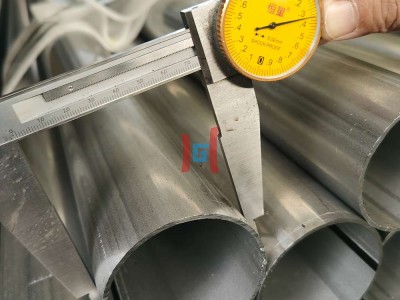
เหตุใดจึงใช้ท่อเหล็กอลูมิไนซ์ในตัวแลกเปลี่ยนความร้อน | ความต้านทานความร้อน & ผลประโยชน์ด้านต้นทุน
เครื่องแลกเปลี่ยนความร้อนทำงานภายใต้สภาวะที่เรียกร้องซึ่งรวมอุณหภูมิที่สูงขึ้น, ความชื้น, การปั่นจักรยานด้วยความร้อน, และก๊าซที่มีฤทธิ์กัดกร่อน. Material selection directly influences heat transfer efficiency, equipment lifespan, maintenance costs, and overall project economics. For many HVAC, เครื่องทำความร้อนอุตสาหกรรม, combustion, and process equipment applications, aluminized steel pipes provide an effective balance between heat resistance, การป้องกันการกัดกร่อน, and manufacturing cost.
เหตุใดจึงใช้ท่อเหล็กอลูมิไนซ์ในตัวแลกเปลี่ยนความร้อน
Aluminized steel pipes consist of carbon steel coated with an aluminum-silicon alloy through a hot-dip process. The aluminum layer forms a stable oxide film during service, protecting the steel substrate against oxidation while maintaining excellent thermal conductivity and structural strength.
| คุณสมบัติ | Benefit for Heat Exchangers |
|---|---|
| ทนความร้อน | Maintains stable performance during continuous heating cycles. |
| ความต้านทานต่อการเกิดออกซิเดชัน | Protects pipe surfaces from high-temperature scaling. |
| ความต้านทานการกัดกร่อน | Improves durability in condensate and humid operating environments. |
| ความสามารถในการขึ้นรูป | รองรับการโค้งงอ, การขยายตัว, การเชื่อม, and tube fabrication. |
| Cost efficiency | Lower material cost than most stainless steel alternatives. |
Material Selection Criteria
Selecting heat exchanger tubing involves evaluating the complete operating environment rather than temperature alone.
| Selection Factor | Engineering Consideration |
|---|---|
| Operating temperature | Continuous and peak temperature determine coating stability. |
| Working medium | Air, combustion gas, steam, or process gas require different corrosion resistance. |
| Condensation | Frequent moisture increases corrosion requirements. |
| Pressure | Wall thickness must satisfy mechanical design standards. |
| อายุการใช้งาน | Longer design life may justify higher-performance materials. |
Comparison with Other Heat Exchanger Materials
| วัสดุ | ความต้านทานความร้อน | ความต้านทานการกัดกร่อน | Relative Cost |
|---|---|---|---|
| เหล็กกล้าคาร์บอน | ปานกลาง | ต่ำ | ต่ำ |
| เหล็กอลูมิเนต | สูง | สูง | ปานกลาง |
| 409 สแตนเลส | สูง | สูง | Medium to High |
| 304 สแตนเลส | สูง | ยอดเยี่ยม | สูง |
Typical Heat Exchanger Applications
- HVAC heat exchanger tubes
- Industrial air heaters
- Gas-fired furnace heat exchangers
- Boiler heat recovery systems
- Drying equipment
- Industrial combustion systems
- Process gas heating equipment
- Agricultural grain dryers
Industry Application Example
A commercial HVAC equipment manufacturer originally used galvanized tubing for its combustion heat exchanger assemblies. After repeated warranty claims caused by high-temperature oxidation, the manufacturer switched to aluminized steel pipes. Field performance showed significantly improved oxidation resistance, reduced maintenance frequency, and longer equipment service life while maintaining competitive manufacturing costs.
In another industrial air heater project, aluminized steel tubing replaced stainless steel in sections where operating temperatures remained within the coating’s design range. The redesign reduced raw material costs while maintaining required durability and thermal performance.
Manufacturing Advantages
Aluminized steel pipes are compatible with standard manufacturing processes including laser cutting, tube bending, roll forming, robotic welding, การขยายตัว, and end forming. Their excellent dimensional consistency supports high-volume production with stable product quality.


How Teda Ganghua Supports Heat Exchanger Manufacturers
Teda Ganghua supplies aluminized steel pipes for heat exchanger manufacturing with stable dimensions, consistent coating quality, และบริการการประมวลผลที่ยืดหยุ่น. Available solutions include custom lengths, tube cutting, pipe fabrication, บรรจุภัณฑ์ส่งออก, and bulk supply for OEM manufacturers and industrial equipment producers.
View available specifications at
ท่อเหล็กอลูมิไนซ์.
คำถามที่พบบ่อย
Why are aluminized steel pipes commonly used in heat exchangers?
They offer an excellent balance of oxidation resistance, การป้องกันการกัดกร่อน, ความต้านทานความร้อน, ความสามารถในการผลิต, and overall cost.
Can aluminized steel replace stainless steel in heat exchangers?
In many moderate-temperature applications, ใช่. For extremely aggressive corrosion or very high operating temperatures, stainless steel may still be required.
Are aluminized steel pipes easy to fabricate?
ใช่. They are suitable for cutting, ดัด, การเชื่อม, การขยายตัว, and automated manufacturing processes.
What industries commonly use aluminized steel heat exchanger tubing?
เครื่องปรับอากาศ, เครื่องทำความร้อนอุตสาหกรรม, หม้อไอน้ำ, เตาหลอม, agricultural drying equipment, and process heating systems frequently use aluminized steel tubing.
Does Teda Ganghua provide custom processing services?
ใช่. Teda Ganghua offers custom cutting, tube processing, บรรจุภัณฑ์ส่งออก, และโซลูชันการจัดหาที่ยืดหยุ่นสำหรับผู้ผลิตเครื่องแลกเปลี่ยนความร้อนทางอุตสาหกรรม.