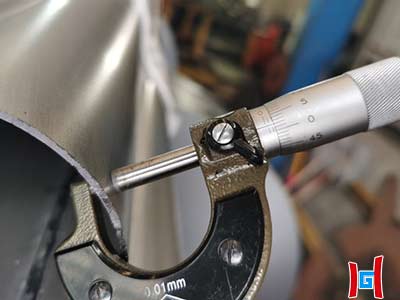
Chuyển đổi khối lượng lớp phủ: Giải thích một mặt và hai mặt
Khi so sánh thông số kỹ thuật lớp phủ kim loại, one of the most common purchasing mistakes is confusing the total coating mass on both sides with the coating mass on a single side. The difference can significantly affect material comparisons, incoming inspection results, and supplier qualification. For aluminum-silicon-coated steel, a designation such as AS120 under EN 10346 generally refers to a nominal coating mass of 120 g/m² across both surfaces, not 120 g/m² on each surface. Tuy nhiên, other standards and commercial specifications may express coating mass differently, so the measurement basis must always be verified before comparing technical data.
1. Why Single-Side and Double-Side Coating Mass Are Different
Coating mass describes the amount of metallic coating applied to a defined area of steel. The key question is whether the reported value represents one surface or the combined mass of both surfaces.
Double-side coating mass
This is the combined coating mass on the top and bottom surfaces, expressed in g/m² of steel sheet area. It is commonly used for coating designations under EN 10346.
Single-side coating mass
This represents the coating mass on one specified surface per square metre of sheet area. It is useful when assessing surface-specific requirements, particularly when the two sides have different coating levels.
These two figures are not interchangeable. If a specification states 120 g/m² for both surfaces, it does not mean that each side carries 120 g/m -mét. Conversely, a requirement of 120 g/m² per side would imply a combined coating mass of approximately 240 g/m² if both sides meet that requirement.
2. How to Convert Coating Mass Correctly
When the coating is distributed equally across both sides, the following equations provide a straightforward conversion.
Double-side coating mass
Mtotal = Mside 1 + Mside 2
For an equal coating distribution
Mper side = Mtotal ÷ 2
All coating mass values are expressed in g/m² of sheet area.
These equations are simple, but the equal-distribution assumption is important. Actual production may result in different coating masses on the two surfaces. Dividing a double-side result by two therefore provides an average per-side value, not proof that each surface independently meets a specified minimum.
Conversion examples
| Double-side mass (g/m -mét) | Average per side (g/m -mét) | Combined mass if the stated value applies to each side (g/m -mét) |
|---|---|---|
| 60 | 30 | 120 |
| 80 | 40 | 160 |
| 100 | 50 | 200 |
| 120 | 60 | 240 |
| 150 | 75 | 300 |
Ghi chú: The per-side figures in the second column assume an equal coating distribution. The third column illustrates the arithmetic conversion when the stated coating mass is required independently on each surface; it is not an automatic interpretation of a standard coating designation.
3. How EN 10346 Defines Coating Mass
For continuously hot-dip coated flat steel products covered by EN 10346, coating designations identify both the coating type and its nominal coating mass. Under the standard’s conventional designation system, the nominal mass is expressed as the total coating mass on both surfaces.
Ví dụ, AS120 identifies an aluminum-silicon coating designation with a nominal coating mass of 120 g/m² across both surfaces. It should not be interpreted as 120 g/m² on each side.
| Coating designation | Nominal total mass, both sides (g/m -mét) | Equal-distribution average per side (g/m -mét) |
|---|---|---|
| AS060 | 60 | 30 |
| AS080 | 80 | 40 |
| AS100 | 100 | 50 |
| AS120 | 120 | 60 |
| AS150 | 150 | 75 |
The table illustrates the designation basis and the arithmetic average only. Actual coating distribution may be uneven, and applicable acceptance criteria must be checked against the relevant edition of the standard, the specified test method, and the purchase agreement.
Triple-spot and single-spot test results
Another common source of confusion is the difference between triple-spot and single-spot test values. These terms describe sampling and evaluation procedures, not simply the number of coated surfaces being measured.
- Triple-spot test: Evaluates coating mass using a set of test results and an applicable averaging procedure. Under the relevant EN 10346 requirements, the coating mass is assessed against the specified acceptance criteria.
- Single-spot test: Evaluates a specific test location and is subject to its own acceptance requirements.
- Surface distribution: A total result across both surfaces does not establish that the coating is divided equally between them.
Always compare test results with the corresponding column and test method in the applicable standard. A single-spot acceptance value should not be confused with a nominal designation or an independently guaranteed minimum for each side.
4. Why Coating Mass Cannot Be Converted Directly Into Thickness
Coating mass and coating thickness are related, but they are different physical measurements. Mass is expressed in g/m², whereas thickness is expressed in micrometres (µm). Converting one into the other requires the appropriate coating density and a clear definition of whether the mass represents one side or both sides.
For a uniform coating on both surfaces, an approximate conversion is:
t ≈ Mtotal ÷ (2 × ρ)
Where t is the average thickness per side in µm, Mtotal is the combined coating mass in g/m², and ρ is the coating density in g/cm³.
This simplified relationship assumes equal coating thickness on both surfaces and a uniform coating density. For aluminum-silicon coatings, the coating structure includes alloy layers, so a simplified density calculation may not exactly reproduce measured thickness.
Ví dụ, a double-side coating mass of 120 g/m² cannot automatically be treated as a thickness of 120 µm or as 120 g/m2 mỗi bên. The correct thickness estimate depends on the material’s coating density and the distribution of coating across the two surfaces.

5. Common Procurement and Inspection Mistakes
6. How to Specify Coating Mass in a Purchase Order
A well-written purchase order should eliminate ambiguity before production begins. Procurement teams should specify the coating designation, applicable standard and edition, cơ sở đo lường, inspection method, and any special requirements for the individual surfaces.
- State the coating type and grade, such as an aluminum-silicon-coated steel grade where applicable.
- Identify the governing standard and edition instead of relying on a designation alone.
- Confirm whether the nominal mass refers to both surfaces or one surface.
- Define any minimum or maximum coating mass required for each side.
- Identify the applicable test method and acceptance criteria.
- Request inspection records and material documentation that use the same units and measurement basis as the purchase order.
For applications requiring coated steel tubes, these checks should be coordinated with tube dimensions, yêu cầu hình thành và hàn, and the condition of the coating after processing. Teda Ganghua supports procurement discussions for ống thép tráng nhôm, helping buyers clarify product specifications and the documentation required for technical evaluation. Confirm the applicable product standard and coating requirements before placing an order.
Câu hỏi thường gặp
1. Does AS120 mean 120 g/m² on each side?
KHÔNG. Under the conventional EN 10346 designation system, AS120 refers to a nominal coating mass of 120 g/m² across both surfaces. An equal-distribution average would be 60 g/m2 mỗi bên, but the actual coating may not be distributed equally.
2. How do I convert coating mass per side into double-side coating mass?
If the specified coating mass is the same on both surfaces, multiply the per-side value by two. Ví dụ, 60 g/m² per side corresponds to a combined mass of 120 g/m -mét. If the two sides have different requirements, add their individual values instead.
3. Is double-side coating mass always divided equally between the two surfaces?
KHÔNG. The combined value does not guarantee equal distribution. If each surface must meet a separate minimum, specify that requirement explicitly and use an appropriate inspection method.
4. Can coating mass in g/m² be converted directly into coating thickness in µm?
Not without additional information. The conversion requires the coating density and a clear measurement basis. For coated steel with alloy layers, chiều dày tính toán là ước tính và không thay thế phép đo hoặc phương pháp chấp nhận hiện hành.
5. Tôi nên kiểm tra những gì khi chứng chỉ lớp phủ của nhà cung cấp sử dụng cơ sở đơn vị khác?
Xác nhận xem giá trị được báo cáo là cho mỗi bên hay cho cả hai bên, xác định tiêu chuẩn áp dụng và phương pháp thử nghiệm, và xác minh các tiêu chí chấp nhận. Yêu cầu nhà cung cấp làm rõ các đơn vị không nhất quán trước khi chấp nhận nguyên liệu.