- Sự miêu tả
Sự miêu tả
Buying an aluminized steel tube starts with one terminology check: are you actually asking for a tube or a pipe? The distinction affects how dimensions are quoted, how wall thickness is specified, how a supplier prepares a stock list, and ultimately whether two quotations are comparing the same product. Tube is normally identified by outside diameter and wall thickness, while pipe is commonly ordered by nominal pipe size together with a wall-thickness schedule. For buyers sourcing exhaust components, heat-resistant tubing, fabricated assemblies, or general industrial sections, putting the dimensional basis into the inquiry is more important than simply writing “steel tube.”
Tube vs Pipe: Start With the Dimensional System
The most practical distinction is the way the product is dimensioned. A tube inquiry normally gives the outside diameter × wall thickness, for example 50.8 × 1.5 mm. A pipe inquiry may instead specify a nominal pipe size and schedule, such as NPS 2 with a selected schedule. The nominal size is not necessarily the measured outside diameter.
This matters because a supplier receiving “2-inch aluminized pipe, 1.5 mm wall” may need to clarify whether the buyer wants a pipe-size product or a tube with an actual 2-inch outside diameter. The two descriptions can lead to different dimensional interpretations, tooling requirements, stock searches, and quotations.
| Mục | Tube | Đường ống |
|---|---|---|
| Typical dimensional description | Outside diameter × wall thickness | Nominal pipe size + schedule or specified wall |
| Ví dụ | 50.8 × 1.5 mm | NPS 2 + specified schedule |
| Primary purchasing concern | Actual OD, tường, length and forming requirements | Nominal size, schedule, standard and service requirement |
| Common application logic | Chế tạo, exhaust routing, mechanical assemblies and formed parts | Fluid or gas conveyance where pipe sizing conventions apply |
ASTM A787/A787M is specifically associated with electric-resistance-welded metallic-coated carbon steel mechanical tubing, while ASTM A463/A463M covers aluminum-coated steel sheet used in relevant aluminized constructions. This is why a purchase order should identify the applicable product standard rather than relying on the generic phrase “aluminized steel.”
Why a Wrong Term Can Change the Quotation
Consider an inquiry that simply says “2 inch aluminized steel pipe, 1.5 độ dày mm, 6 m”. A supplier may interpret “2 inch” as a nominal pipe size. Another supplier may interpret it as an actual 50.8 mm outside diameter. Even if both suppliers quote 1.5 độ dày thành mm, the products may not have identical dimensions.
A clearer inquiry would state one of the following:
Tube format: Round tube, TỪ 50.8 mm × WT 1.5 mm × length 6000 mm.
Pipe format: Đường ống, NPS 2, specified schedule, chiều dài 6000 mm.
Coating requirement: Aluminum-based coating, coating type and coating mass to be confirmed against the applicable specification.
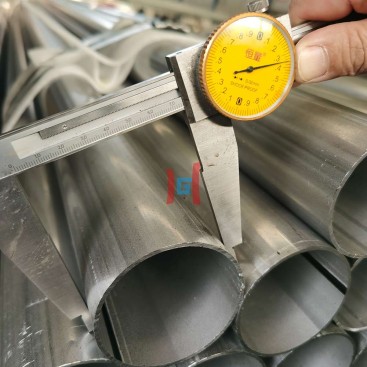
For fabrication projects, actual OD is particularly important because bends, clamps, sleeves, muffler connections, dấu ngoặc đơn, mandrels, expanding tools and insertion joints are designed around physical dimensions rather than the nominal name alone. If the component must connect to an existing assembly, include the measured mating diameter and allowable dimensional tolerance in the inquiry.
A Practical Stock List for Buyers
A useful stock list should not be organized by diameter alone. Procurement teams normally need at least four dimensions of information: đường kính ngoài, độ dày của tường, coating configuration and available length. A fifth field should identify whether the item is standard stock, cut-to-length stock, or made to order.
| OD Range | Typical Wall Range | Coating Route | Typical Supply Length | Typical Purchasing Use |
|---|---|---|---|---|
| 12.7–25.4 mm | 0.8–2,0mm | Al-Si or aluminum coating | 1–6 m | Small exhaust and formed components |
| 25.4–50.8 mm | 1.0–2,5 mm | Al-Si or aluminum coating | 1–6 m | Exhaust routing and general fabrication |
| 50.8–101.6 mm | 1.2–3,0mm | Al-Si or aluminum coating | 3–6 m | Khí thải, ducts and industrial assemblies |
| 101.6–219 mm | 1.5–4,0mm | Specified coating system | 3–12 m | Large-diameter fabrication and industrial service |
| 219–380 mm | 2.0–4.6 mm | Specified coating system | Mill or custom length | Large mechanical tubing applications |
The ranges above are practical sourcing categories rather than a promise that every combination is continuously available. ASTM A787 covers a substantially broader dimensional scope for metallic-coated mechanical tubing, and actual stock availability depends on the supplier’s production schedule, đặc điểm kỹ thuật lớp phủ, base steel and order quantity.
Aluminum-Silicon Coating vs Pure Aluminum Coating
“Aluminized” does not always describe exactly the same coating chemistry. Two common purchasing routes are an aluminum-silicon coating and a coating based primarily on aluminum. The selection should follow the operating environment, forming requirement, corrosion exposure and applicable material specification.
An aluminum-silicon coating is widely associated with high-temperature steel products because the silicon addition supports the coating’s metallurgical interaction with the steel substrate. It is commonly considered for exhaust and thermal applications where repeated heating and cooling occur. A primarily aluminum coating can be selected when the specification emphasizes aluminum-rich surface protection and the forming or service conditions fit that coating system.
| Selection Factor | Aluminum-Silicon Route | Aluminum-Rich Route |
|---|---|---|
| Typical reason for selection | Heat and oxidation exposure combined with corrosion protection | Aluminum-rich surface protection and defined coating requirements |
| Common service consideration | Exhaust and thermal cycling | Corrosion-resistant fabricated components and specified coating applications |
| What to specify | Loại sơn, coating mass, chất nền, standard and forming requirement | Coating composition, coating mass, substrate and service environment |
Do not use coating names as a substitute for the specification. A purchase order should identify the relevant standard, coating designation or mass, lớp nền, dimensions and inspection requirements. If the tube will be bent or expanded after purchase, the supplier should also know the forming operation before selecting the material.
What to Check Before Ordering From Stock
Stock availability is only useful when the available dimensions match the finished component. Before releasing an order, check the following items:
- Outside diameter: confirm the actual measured OD, not only the nominal inch designation.
- Độ dày của tường: confirm whether the quoted value represents the ordered finished wall dimension.
- Lớp phủ: identify the coating chemistry, designation and coating mass required by the application.
- Inside surface: confirm whether the internal surface must also be coated and whether internal weld flash is controlled.
- Chiều dài: distinguish mill length, fixed length and cut-to-length pieces.
- End condition: specify plain, deburred, beveled, expanded, reduced, flared or otherwise formed ends when required.
- Điều tra: confirm dimensional inspection, coating verification, mechanical requirements and material documentation.
Minimum Order Quantity and Cut-to-Length Service
Not every stock size needs to be purchased as a full mill length. For fabrication projects, cut-to-length service can reduce downstream sawing, handling and material preparation. Tuy nhiên, cutting changes the purchasing calculation because the supplier may need to account for cutting tolerance, saw kerf, nesting efficiency, bundle quantities and the number of pieces per standard length.
For repeat production, it is useful to separate the requirement into three levels:
Best suited to buyers with their own cutting equipment or applications using standard lengths.
Useful when finished components require repeatable lengths before bending or assembly.
Suitable for projects requiring bending, sự hình thành cuối cùng, drilling, perforation or other downstream processing.
For low-volume trials, ask whether mixed sizes can be consolidated into one shipment and whether the supplier can provide cut pieces from existing stock. For regular production, provide an annual or monthly demand estimate so the supplier can evaluate stock allocation and production planning.
Teda Ganghua Supply and Customization Support
Teda Ganghua supports procurement teams that need more than a generic material description. The sourcing process can be based on actual OD × wall thickness, đặc điểm kỹ thuật lớp phủ, mác thép, length and application, helping buyers avoid the common problem of comparing a tube quotation with a pipe quotation that uses a different dimensional system.
For exhaust, thermal and fabricated applications, Teda Ganghua can coordinate stock-size selection together with cut-to-length and downstream processing requirements. Buyers can provide a drawing, dimensional list or simple specification such as “OD × WT × length + lớp phủ + Số lượng,” and the requirement can then be matched against available production and stock configurations. For buyers looking for ống thép tráng nhôm, specifying the coating route and actual dimensions at the beginning makes the inquiry easier to verify and quote.
A complete commercial inquiry should include the product form, tiêu chuẩn, vật liệu cơ bản, đường kính ngoài, độ dày của tường, loại lớp phủ, coating mass or designation, chiều dài, Số lượng, end condition, yêu cầu xử lý, inspection documents and destination. This format gives both sides enough information to determine whether a stock product, cut-to-length product or customized production route is appropriate.
Recommended Inquiry Format
Sản phẩm: Round aluminized steel tube
Tiêu chuẩn: ASTM A787/A787M or specified equivalent
Vật liệu cơ bản: Required carbon steel grade
Dimensions: OD ___ mm × WT ___ mm
Lớp phủ: Al-Si or aluminum-based, designation/mass ___
Chiều dài: ___ mm fixed length or ___ m stock length
Quantity: ___ pieces / ___ tonnes
Xử lý: Cắt / uốn cong / sự hình thành cuối cùng / drilling / none
Điều tra: Dimensional and coating requirements
Documentation: Material certificate and inspection documents as required
Câu hỏi thường gặp
Is an aluminized steel tube the same as an aluminized steel pipe?
Không nhất thiết. The terms often describe different purchasing conventions. Tube is commonly specified by actual outside diameter and wall thickness, while pipe is commonly ordered by nominal pipe size and schedule. Always state the actual dimensions and applicable standard when the product must fit an existing assembly.
How should I write the dimensions in a purchase inquiry?
For a tube, use a format such as 50.8 mm OD × 1.5 mm wall × 6000 mm length. If you require pipe, state the nominal pipe size, schedule or specified wall thickness, applicable standard and length.
Which coating should be selected for exhaust applications?
An aluminum-silicon coating is commonly considered for exhaust and thermal applications because the coating system is designed for elevated-temperature exposure and corrosion protection. The final choice should follow the required standard, nhiệt độ hoạt động, đạp xe nhiệt, forming process and coating specification.
Can standard stock be cut to a specified length?
Đúng, dịch vụ cắt theo chiều dài có thể được sắp xếp khi thiết bị và cấu hình kho hàng của nhà cung cấp cho phép. Cuộc điều tra phải nêu rõ chiều dài đã hoàn thành, Số lượng, dung sai cắt cho phép và liệu có cần phải mài nhẵn hoặc xử lý phần cuối khác hay không.
Tôi nên gửi thông tin gì cho báo giá tùy chỉnh?
Cung cấp mẫu sản phẩm, tiêu chuẩn, mác thép, TỪ, độ dày của tường, loại lớp phủ và khối lượng lớp phủ, chiều dài, Số lượng, end condition, yêu cầu xử lý, tài liệu kiểm tra và nơi giao hàng. Một bản vẽ đặc biệt hữu ích khi uốn, mở rộng, hoạt động khử hoặc hình thành khác có liên quan.