
الانتشار المتبادل بين الحديد والألمنيوم في الفولاذ المغطى بالألمنيوم: تدهور طلاء درجة الحرارة العالية
Aluminized steel is often selected for components exposed to elevated temperatures because its aluminum-rich surface can form a protective aluminum oxide layer that slows oxidation of the underlying steel. لكن, this protection is not permanent. During prolonged high-temperature exposure, iron and aluminum atoms gradually diffuse across the coating-substrate interface. This process changes the original coating structure, consumes the aluminum-rich layer, and can eventually reduce its ability to protect the steel. Understanding iron-aluminum interdiffusion helps engineers evaluate coating durability, درجة حرارة التشغيل, and expected service life more accurately.
1. What Happens Inside an Aluminized Steel Coating at High Temperature?
يكتب 1 aluminized steel typically consists of a steel substrate, an iron-aluminum intermetallic diffusion layer, and an aluminum-rich outer coating. The coating is produced through a hot-dip process in which the steel strip passes through a molten aluminum-silicon bath. During coating formation, iron from the steel reacts with aluminum and creates an intermetallic layer at the interface.
At normal service temperatures, the aluminum-rich surface can develop a compact aluminum oxide film. This oxide film acts as a barrier against further oxidation. When the material is exposed to elevated temperatures for extended periods, لكن, diffusion continues beneath the oxide layer.
Iron atoms move outward from the steel substrate toward the aluminum-rich coating, while aluminum atoms diffuse inward toward the steel. The resulting chemical and structural changes gradually modify the original coating system.
Key mechanism: High-temperature exposure does not simply burn away the aluminized coating. Iron and aluminum interdiffusion changes the coating composition and creates or enlarges iron-aluminum intermetallic regions, progressively consuming the original aluminum-rich reservoir.
2. Iron-Aluminum Interdiffusion: How the Coating Changes
Iron-aluminum interdiffusion is a solid-state diffusion process. في درجات حرارة مرتفعة, atoms gain sufficient mobility to migrate through the metallic structure. The concentration gradient between the steel substrate and the aluminum-rich coating provides a driving force for this redistribution.
As diffusion proceeds, the original interface becomes less distinct. Different iron-aluminum intermetallic phases may form depending on local composition and temperature. In the Fe-Al system, phases such as Fe2آل5 and FeAl3 (often represented using the alternative notation Fe4آل13 in some literature) can be relevant to aluminized coating structures. The actual phase distribution depends on coating composition, processing history, and exposure conditions.
The main stages of coating evolution
| Stage | Metallurgical change | Potential consequence |
|---|---|---|
| Initial condition | Aluminum-rich outer coating with an intermetallic interface | Available aluminum supports protective oxide formation |
| Early exposure | Iron and aluminum begin redistributing across the interface | The intermetallic region changes in thickness and composition |
| Extended exposure | Interdiffusion consumes more of the aluminum-rich region | The remaining aluminum reservoir becomes smaller |
| Advanced degradation | The coating becomes increasingly iron-rich and its protective capacity may decline | Oxidation resistance can deteriorate, exposing the substrate to greater attack |
The important point is that coating degradation is a progressive metallurgical change. The surface may still look metallic even after the aluminum-rich region has been substantially reduced. Visual inspection alone therefore cannot reliably establish the remaining high-temperature protection.
3. Why Does the Aluminum-Rich Layer Get Consumed?
The original aluminized coating contains a relatively high concentration of aluminum compared with the steel substrate. This difference in chemical composition drives interdiffusion during high-temperature exposure.
As iron migrates into the coating, it reacts with aluminum and contributes to the formation or growth of iron-aluminum intermetallic phases. Aluminum also moves inward into the steel substrate. Both processes reduce the amount of aluminum remaining in the original outer coating region.
This is why engineers sometimes describe the coating as being gradually “eaten away.” The phrase refers to the loss of the aluminum-rich protective reservoir through diffusion and phase transformation, rather than simple mechanical removal.
Three changes occur simultaneously
- Iron enrichment: Iron diffuses from the steel substrate into the coating, changing its local chemical composition.
- Aluminum depletion: Aluminum diffuses toward the substrate and is incorporated into the diffusion zone, reducing the aluminum concentration in the outer region.
- Intermetallic growth: Iron-aluminum phases develop or change in thickness, altering the coating’s microstructure and mechanical behavior.
The rate of these changes is strongly influenced by temperature and exposure time. A component exposed continuously to elevated temperatures may experience substantially more diffusion than one exposed to the same peak temperature for short periods.
4. Temperature and Time: Why Diffusion Accelerates So Quickly
Diffusion in solids is temperature-dependent. As temperature rises, atomic mobility increases and diffusion generally proceeds faster. For many diffusion-controlled processes, the temperature dependence can be described using an Arrhenius relationship:
Diffusion coefficient
D = D0 exp(-Q / RT)
د: diffusion coefficient; د0: pre-exponential factor; Q: activation energy; ر: gas constant; T: absolute temperature.
The equation shows why a relatively small increase in temperature can produce a significant increase in diffusion rate. The exact response depends on the relevant diffusion mechanism, phase, and material condition.
For an idealized diffusion-controlled process, the characteristic diffusion distance is often approximated by:
Characteristic diffusion distance
x ∝ √(Dt)
x: characteristic diffusion distance; د: diffusion coefficient; t: exposure time.
This simplified relationship explains why longer exposure increases diffusion depth, although actual coating growth may involve multiple phases, changing diffusion coefficients, and non-ideal interface conditions.
| Exposure condition | Expected diffusion behavior | Engineering implication |
|---|---|---|
| Lower temperature, short duration | Generally slower interdiffusion | Less coating evolution during the exposure period |
| Moderate temperature, long duration | Diffusion accumulates over time | Long-term aluminum depletion must be considered |
| Higher temperature, short duration | Diffusion can accelerate significantly | Peak-temperature exposure may be important |
| Higher temperature, long duration | Greater potential for intermetallic growth and aluminum depletion | Coating life and remaining protective capacity require careful evaluation |
These comparisons describe general trends rather than fixed service-life predictions. Actual performance must be established using the material specification, operating history, and representative testing.
5. Why Iron-Aluminum Intermetallics Can Become a Problem
Iron-aluminum intermetallic phases are a normal part of the aluminized steel coating structure. Their presence is not automatically a defect. The issue is that excessive or unfavorable intermetallic development can change the coating’s mechanical behavior and reduce the amount of aluminum available for continued protective oxide formation.
Some iron-aluminum intermetallic phases are relatively hard and brittle compared with the aluminum-rich outer coating. As the diffusion zone grows, the coating may become less tolerant of deformation and thermal stress. This can increase the risk of cracking or local separation under unfavorable conditions.
Potential effects of excessive diffusion
- Reduced aluminum reserve: Less aluminum remains available at the surface to maintain the protective oxide scale.
- Increased brittleness: A larger intermetallic region can make the coating system more sensitive to deformation and thermal stress.
- Coating cracking: Differences in thermal expansion and local mechanical properties can contribute to cracking during thermal cycling.
- Reduced oxidation protection: Once the aluminum-rich surface can no longer maintain an effective protective scale, oxidation of the steel substrate may accelerate.
It is important not to assume that every increase in intermetallic thickness immediately causes coating failure. The performance of the complete coating system depends on phase distribution, remaining aluminum concentration, oxide-scale integrity, substrate condition, and the service environment.
6. How to Recognize High-Temperature Aluminized Coating Degradation
Coating degradation should be evaluated through a combination of visual inspection, dimensional assessment, and metallurgical examination. A change in surface color can indicate thermal exposure, but it cannot independently confirm the extent of iron-aluminum interdiffusion.
| Inspection method | What it can reveal | القيد |
|---|---|---|
| Visual inspection | Oxide discoloration, visible cracking, flaking, and surface damage | Cannot quantify internal diffusion or remaining aluminum |
| Metallographic cross-section | Coating-layer structure, diffusion-zone development, and cracks | Requires sample preparation and representative sampling |
| SEM-EDS analysis | Element distribution and iron-aluminum concentration gradients | Local analysis; results depend on sampling and measurement conditions |
| Oxidation testing | Mass change and oxidation behavior under controlled conditions | Laboratory results may not reproduce every field condition |
| Coating thickness or mass assessment | Remaining coating quantity, depending on the method | Does not alone identify phase composition or protective capability |
For failure investigations, cross-sectional metallography combined with SEM-EDS is particularly useful. It can help distinguish the aluminum-rich outer region from the iron-aluminum diffusion zone and reveal whether the coating has undergone substantial compositional change.
7. How Coating Selection Can Help Extend Service Life
Since high-temperature diffusion gradually consumes the aluminum-rich coating, selecting an appropriate initial coating level is an important part of material design. A greater coating mass can provide a larger initial coating reserve, but it does not stop diffusion or guarantee a proportional increase in service life.
When selecting Type 1 الفولاذ بالألمنيوم, engineers should consider the following factors together:
- Initial coating mass: Confirm the required coating class and measurement basis, including whether the value covers both sides.
- الركيزة الفولاذية: Check the grade, سماكة, mechanical properties, and intended component design.
- Continuous and peak temperatures: Evaluate actual exposure rather than relying on a single maximum-temperature figure.
- Exposure duration: Consider operating hours, shutdown periods, and thermal cycling frequency.
- Atmosphere composition: Identify oxygen, sulfur compounds, water vapor, and other potentially aggressive gases.
- Fabrication damage: Assess whether cutting, لحام, الانحناء, or forming may locally damage the coating.
Where exposure conditions are severe, it may be necessary to compare different coating systems or heat-resistant steel grades rather than simply increasing the coating mass of the same material.
8. تيدا جانجوا: Aluminized Steel Tubes for High-Temperature Applications
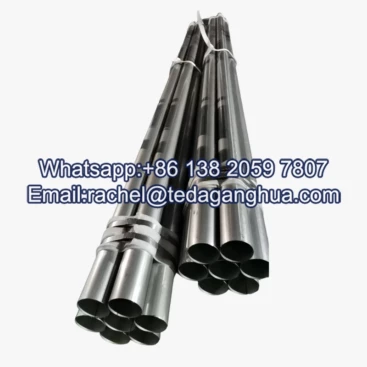
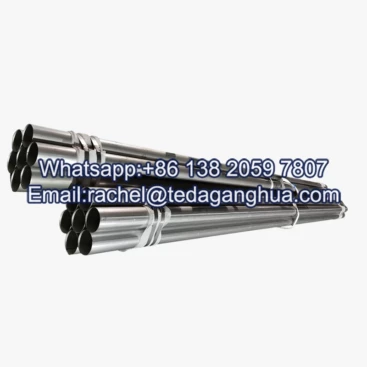
For manufacturers using aluminized steel tubes in exhaust systems, معدات التدفئة الصناعية, مبادلات حرارية, and other elevated-temperature applications, coating selection should be based on both the initial specification and the expected service environment. Teda Ganghua has 20 years of industry experience and has been engaged in export business since 2006, supporting international procurement requirements for steel products and industrial applications.
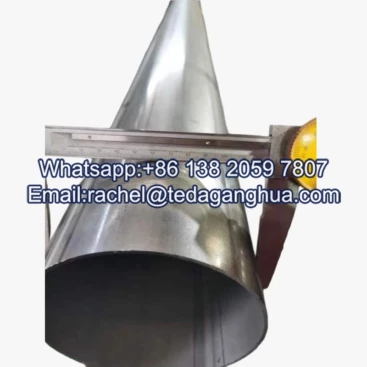
When evaluating aluminized steel tubes, buyers can provide the required outside diameter, سمك الجدار, طول, درجة الصلب, يكتب 1 coating class, المعيار المطبق, and operating conditions. Teda Ganghua can assist with specification confirmation, material documentation, and supply coordination to help procurement teams identify products that match their fabrication and application requirements.
For projects where long-term high-temperature performance matters, buyers should also clarify continuous operating temperature, درجة حرارة الذروة, مدة التعرض, and atmosphere composition. These details help establish a more meaningful material specification than coating designation alone.
Explore أنابيب الصلب بالألمنيوم from Teda Ganghua and submit your required dimensions, مواصفات الطلاء, and service conditions for a project-specific inquiry.
9. الأسئلة المتداولة
Q1: What is iron-aluminum interdiffusion in aluminized steel?
It is the movement of iron and aluminum atoms across the coating-substrate interface during elevated-temperature exposure. This process changes the coating composition and promotes the development or growth of iron-aluminum intermetallic phases.
Q2: Why does high temperature consume the aluminum-rich coating?
Higher temperature increases atomic mobility. Iron diffuses outward from the steel substrate while aluminum moves inward, gradually reducing the aluminum concentration in the original outer coating region.
Q3: Are iron-aluminum intermetallic phases always harmful?
لا. An intermetallic diffusion layer is a normal feature of aluminized steel. لكن, excessive growth or an unfavorable phase structure can increase brittleness and reduce the available aluminum-rich protective reserve.
Q4: Does a heavier aluminized coating prevent iron-aluminum diffusion?
لا. A heavier coating can provide a larger initial aluminum reserve, but it does not eliminate diffusion. درجة حرارة, exposure time, coating composition, and service atmosphere still determine how the coating evolves.
س5: How can engineers determine whether an aluminized coating has been depleted?
Visual inspection can identify obvious surface damage, but it cannot reliably measure internal aluminum depletion. يمكن لتحليل المقطع العرضي للمعادن وSEM-EDS توفير المزيد من المعلومات المباشرة حول هيكل الطلاء وتوزيع الحديد والألومنيوم.


