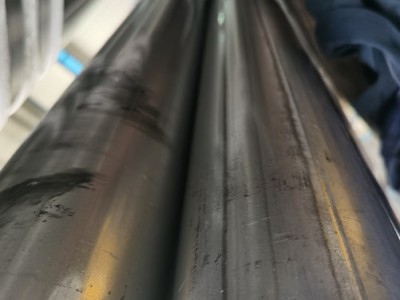
Galvanized Steel Pipes – Applications, Types, and Specifications
Applications of Galvanized Steel Pipes
Galvanized steel pipes are widely used across various industries, including:
- Construction – Structural frameworks, bridges, and highways
- Machinery – Agricultural and petroleum equipment
- Automotive – Railway vehicles and automobile manufacturing
- Industrial Use – Chemical plants, coal mines, and container production
- Greenhouses & Sports Facilities – Supporting structures and frameworks
Types of Galvanized Steel Pipes
Hot-Dip Galvanized Pipes
Hot-dip galvanizing forms a strong zinc-iron alloy layer by immersing steel pipes in molten zinc. This process ensures:
- Uniform Coating – Even distribution of zinc for better protection
- Strong Adhesion – Bonding with the steel for long-term durability
- Corrosion Resistance – Protection against rust and environmental damage
Cold-Dip Galvanized Pipes (Electro-Galvanized)
Cold-dip galvanizing applies a thinner zinc coating via electroplating, making it less durable than hot-dip galvanizing. Due to poor corrosion resistance, cold-galvanized pipes are no longer allowed for water or gas transportation.
Specifications of Galvanized Steel Pipes
Wall Thickness & Weight Coefficients
Galvanized steel pipes come in various nominal wall thicknesses: 2.2, 2.5, 2.8, 3.2, 3.5, 3.8, 4.4, and 5 mm. Their weight coefficient values range from 1.064 to 1.028.
Technical Requirements
- Steel Composition – Must meet the chemical standards outlined in GB/T3091.
- Manufacturing Methods – Pipes are produced using either furnace welding or electric welding, followed by hot-dip galvanizing.
- Threads & Pipe Joints – Threaded galvanized steel pipes must have threads turned after galvanization per YB822 standards. Pipe joints must meet YB238 and YB230 specifications.
- Mechanical Properties – Pipes must meet GB3091 standards for strength and flexibility.
- Zinc Coating Uniformity – Pipes must withstand five consecutive immersions in copper sulfate without turning red.
- Cold Bending Test – Pipes up to 50mm in diameter must pass a 90° bending test without cracks or zinc peeling.
- Water Pressure Testing – Pipes undergo water pressure or eddy current testing as per GB3092 standards.
Mechanical Properties of Galvanized Steel Pipes
- Tensile Strength (σb) – Measures maximum resistance before breaking.
- Yield Point (σs) – Indicates the stress level where the pipe deforms permanently.
- Elongation (σ) – Measures flexibility and ductility.
- Hardness (HB) – Brinell hardness test determines the pipe’s ability to resist indentation.
Material Composition & Performance Factors
- Carbon – Increases hardness but reduces flexibility.
- Sulfur & Phosphorus – High amounts weaken steel, causing brittleness.
- Manganese – Enhances strength and wear resistance.
- Silicon – Improves hardness but decreases toughness.
- Zinc – Provides corrosion resistance through hot-dip galvanizing.
Rust Removal Methods
- Cleaning – Organic materials removed with solvents.
- Mechanical Removal – Wire brushes remove rust and welding slag.
- Pickling – Acid treatment removes oxide layers before galvanization.
Connection Methods for Galvanized Steel Pipes
Threaded & Welded Connections
Galvanized steel pipes can be joined using threads, welding, or rolling grooves.
Rolling Groove Issues & Solutions
Weld Cracking
- Grind the inner weld seam to reduce groove resistance.
- Align the steel pipe and groove equipment properly.
- Apply force gradually during the groove rolling process.
Pipe Fracture
- Adjust pressing speed and ensure even force application.
- Verify groove dimensions using calipers.
Groove Formation Standards
- The groove surface should be smooth and free of defects.
- The groove width and depth must be uniform.
- Lubricate the rubber sealing ring before installation.
Why Choose a Reliable Galvanized Steel Pipe Supplier?
A trusted galvanized steel pipe factory ensures high-quality products that meet industry standards. Choosing a reputable galvanized steel pipe supplier guarantees:
- Superior corrosion resistance
- Accurate wall thickness and dimensions
- Compliance with international quality standards
For durable and high-performance galvanized pipes, partner with a professional galvanized steel pipe factory to ensure long-lasting, reliable solutions.