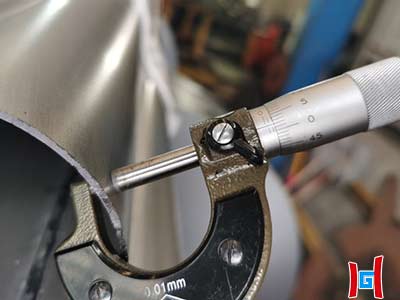
Valore R e dimensione del grano nell'acciaio per imbutitura profonda: Guida alla formabilità
Quando si seleziona l'acciaio per applicazioni di imbutitura profonda, la resistenza alla trazione e l'allungamento da soli non possono prevedere completamente le prestazioni di formatura. Two sheets with similar tensile properties may behave very differently during cup drawing, timbratura, or other demanding forming operations. The difference often lies in their plastic strain ratio, commonly called the r-value, and their grain size and grain structure. These characteristics help explain how effectively a steel sheet resists thinning, distributes deformation, and maintains a consistent surface during forming.
For aluminized steel, the substrate’s forming properties deserve particular attention. The aluminum-based coating does not automatically make a sheet suitable for deep drawing. Buyers must evaluate the substrate grade, mechanical properties, grain structure, condizione del rivestimento, and forming requirements together. Understanding the relationship between r-value and grain size helps procurement teams specify the right substrate rather than relying only on a coating designation such as T1-40.
1. What Does the r-Value Mean in Deep Drawing?
The r-value, or plastic strain ratio, describes how a sheet metal specimen deforms in width relative to its thickness during a tensile test. It is commonly expressed as:
r = εw / εt
Where:
- εw: True plastic strain in the width direction.
- εt: True plastic strain in the thickness direction.
Because plastic deformation in a tensile specimen approximately follows volume constancy, a higher r-value generally indicates that the material tends to deform more in width than in thickness. This is important in deep drawing because excessive thinning can lead to localized failure, splitting, or reduced component strength.
A higher r-value is therefore generally desirable for applications where resistance to thickness reduction is important. Tuttavia, it should not be interpreted as a guarantee of successful forming. The actual result also depends on the component geometry, blank-holder force, lubrication, die clearance, forming speed, and material anisotropy.
2. Why Is the Average r-Value Not Enough?
Rolled steel sheet is not perfectly isotropic. Its mechanical behavior can vary with the direction of testing relative to the rolling direction. This directional variation is called planar anisotropy.
To evaluate it, tensile specimens are commonly taken at different angles, typically 0°, 45°, and 90° to the rolling direction. The corresponding plastic strain ratios are used to calculate the normal anisotropy and planar anisotropy indicators.
The average normal anisotropy is commonly calculated as:
r̄ = (r0 + 2r45 + r90) / 4
The planar anisotropy is commonly expressed as:
Δr = (r0 – 2r45 + r90) / 2
Here, r0, r45, and r90 represent the r-values measured at the respective specimen orientations.
The average r-value indicates the sheet’s overall resistance to thinning, while Δr describes the difference in directional forming behavior. A material may have a favorable average r-value but still show considerable planar anisotropy, potentially causing uneven material flow and earing during cup drawing.
3. How r-Value Influences Deep-Drawing Performance
During deep drawing, the sheet flange is pulled toward the die cavity while material experiences different stress and strain conditions across the component. The material must flow without excessive thinning, tearing, or wrinkling.
A higher average r-value generally helps the sheet resist thickness reduction under tensile deformation. This can improve the material’s ability to maintain wall thickness in drawn components. By contrast, a low r-value may increase the tendency toward thinning, particularly in demanding geometries.
Tuttavia, r-value is not the same as the work-hardening exponent, valore n. The two parameters describe different aspects of forming behavior:
| Parametro | What It Describes | Forming Significance |
|---|---|---|
| r-value | Width strain relative to thickness strain | Resistance to thinning during deformation |
| valore n | Work-hardening behavior during plastic deformation | Ability to distribute strain and delay localized necking |
| Allungamento | Total extension in a tensile test | General indication of tensile ductility |
For demanding deep-drawing applications, these indicators should be assessed together. A sheet with high elongation but low r-value may not provide the same resistance to thinning as a sheet designed for deep drawing. Likewise, a favorable r-value cannot compensate for inadequate work-hardening behavior or unsuitable forming conditions.
4. What Grain Size Tells You About a Deep-Drawing Substrate
Grain size describes the dimensions of individual crystallographic grains in the steel microstructure. It is commonly evaluated using metallographic examination and standardized grain-size rating methods.
Grain structure influences mechanical behavior because grain boundaries affect dislocation movement and plastic deformation. In many conventional ferritic sheet steels, finer grains generally contribute to higher strength through grain-boundary strengthening. Tuttavia, the relationship between grain size and deep-drawing performance is more complicated than simply choosing the finest possible grains.
For deep-drawing steel, a suitable and reasonably uniform grain structure is important. Excessively coarse grains can contribute to surface roughness, orange-peel appearance, and non-uniform deformation. A very fine grain structure may increase strength, but its effect on forming performance depends on the steel’s chemistry, texture, processing history, and final mechanical properties.
Perciò, grain size should be considered alongside crystallographic texture, r-value, valore n, forza di snervamento, and elongation. A grain-size number alone cannot establish whether a substrate is suitable for a specific drawing operation.
5. Grain Uniformity Matters as Much as Average Grain Size
Two steel sheets may have similar average grain-size ratings but different microstructural uniformity. One may contain relatively consistent grains throughout the examined area, while another may show a mixture of fine and coarse grains.
Such differences can affect local deformation. Areas with different grain structures may respond differently during forming, potentially creating uneven surface appearance or localized strain concentrations.
When evaluating a deep-drawing substrate, metallographic inspection should therefore consider:
- Average grain size: The general scale of the grain structure.
- Grain-size distribution: Whether the microstructure is relatively uniform or contains abnormal coarse grains.
- Microstructural consistency: Whether different locations across the sheet show comparable structures.
- Texture: The preferred crystallographic orientations developed during rolling and annealing.
- Condizioni superficiali: Whether the substrate has defects that could become more visible after forming.
For critical components, metallographic assessment should use representative sampling and an appropriate test method. A single micrograph from one location may not represent the entire coil or sheet batch.
6. The Connection Between Grain Structure and r-Value
Grain size and r-value are related to the steel’s processing history, but they are not interchangeable measurements. The r-value is strongly influenced by crystallographic texture, which develops during hot rolling, cold rolling, and annealing.
In many deep-drawing-quality low-carbon steels, suitable recrystallization texture can promote a higher average r-value. This texture encourages deformation behavior that helps the sheet resist thinning. Grain size may also influence the final mechanical response, but it cannot independently predict the r-value.
The distinction is important when comparing suppliers. A metallographic report showing a fine grain structure does not prove that the material has a high r-value. Similarly, a tensile test showing favorable r-values does not fully describe grain uniformity or surface-forming behavior.
For reliable material qualification, buyers should request both mechanical test data and microstructural evidence when the application requires strict deep-drawing performance.
7. How to Evaluate r-Value and Grain Size Together
A practical assessment should combine standardized mechanical testing with metallographic inspection. The following table summarizes the main indicators and their purpose.
| Elemento di ispezione | What to Check | Why It Matters |
|---|---|---|
| Average r-value | r̄ from directional tensile tests | Evaluates resistance to thinning |
| Planar anisotropy | Δr from 0°, 45°, and 90° tests | Helps assess directional variation and earing tendency |
| valore n | Work-hardening exponent over the specified strain range | Indicates strain-distribution behavior |
| Grain size | Metallographic grain-size rating | Characterizes microstructural scale |
| Grain uniformity | Grain-size distribution and representative locations | Helps identify local microstructural variation |
| Condizioni superficiali | Roughness, difetti, and coating integrity where applicable | Reduces the risk of visible defects after forming |
Testing should follow the applicable material specification and agreed test methods. Per esempio, tensile testing and plastic strain ratio evaluation may be performed under relevant ISO or ASTM procedures, while grain-size measurement should follow the specified metallographic standard. Test direction, specimen location, strain range, and reporting method should be agreed before comparing results from different suppliers.
8. Why Coating Class T1-40 Does Not Define Deep-Drawing Quality
For aluminized steel, the coating designation and the substrate’s forming properties describe different characteristics. T1-40 is associated with an aluminized coating classification, not a guaranteed r-value, grain-size rating, or deep-drawing grade.
Two products with the same coating class may use different substrate grades and manufacturing routes. Their deep-drawing performance can therefore differ even when the coating designation is identical.
Before ordering coated steel for a drawing application, buyers should confirm:
- The substrate grade and applicable material standard.
- The required r-value or average r-value, if specified.
- The acceptable planar anisotropy or earing performance, where relevant.
- The required n-value and elongation for the forming operation.
- The grain-size and microstructural requirements, if critical to the component.
- The coating type, coating class, and measurement basis.
- The intended forming depth, geometria, and surface-quality expectations.
It is also important to verify that the selected coating process and material condition are compatible with the forming operation. Coating adhesion, surface friction, lubrication, and coating damage can affect production results even when the substrate has suitable mechanical properties.
9. Common Mistakes When Purchasing Deep-Drawing Steel
Several purchasing mistakes can lead to unexpected forming problems:
- Using elongation as the only selection criterion: Total elongation does not describe directional resistance to thinning.
- Assuming a high r-value guarantees success: Die design, lubrication, blank-holder force, and material anisotropy still affect the result.
- Choosing the finest grain size automatically: Grain size must be assessed with texture and mechanical properties rather than treated as an independent quality ranking.
- Ignoring planar anisotropy: A favorable average r-value may still be accompanied by significant directional differences.
- Confusing coating class with substrate grade: The same aluminized coating designation does not guarantee identical formability.
- Comparing test reports without checking methods: Different specimen directions, test standards, and calculation procedures can make reported values difficult to compare.
The most reliable approach is to define the required forming performance first and then specify the substrate and coating separately. Where the part has strict dimensional or surface requirements, a trial forming test using production-representative tooling is often more informative than relying on material certificates alone.
10. How Teda Ganghua Supports Aluminized Steel Substrate Selection
For procurement managers sourcing aluminized steel for stamping, disegno, or formed components, selecting the coating is only one part of the specification. The substrate grade, spessore, mechanical properties, condizione della superficie, and forming requirements must also be considered before production orders are confirmed.
Teda Ganghua has been engaged in steel export business since 2006, con 20 years of experience in supplying steel products to international customers. Our team can help buyers clarify the technical information required for an inquiry, including substrate grade, spessore, larghezza, coating type, coating class, norma applicabile, and intended forming application.
For projects involving deep drawing, buyers should provide available tensile test results, r-value requirements, grain-size requirements, and component-forming details. These specifications help distinguish a general-purpose coated sheet from a substrate intended for more demanding forming operations.
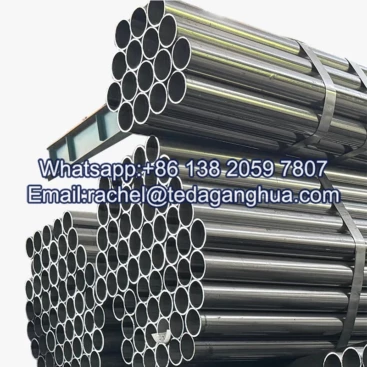
Explore our tubi in acciaio alluminato product range or contact Teda Ganghua with your required dimensions, substrate specification, requisiti di rivestimento, and application details for a more suitable material recommendation.
11. Domande frequenti
Q1. What is a good r-value for deep-drawing steel?
There is no single r-value suitable for every deep-drawing application. A higher average r-value generally indicates better resistance to thinning, but the required value depends on the component geometry, forming severity, grado del materiale, and applicable specification. Buyers should define the target with the material supplier and forming engineer.
Q2. Does a higher r-value always mean better formability?
NO. A higher average r-value can improve resistance to thinning, but it does not describe every aspect of formability. The n-value, allungamento, planar anisotropy, condizione della superficie, and forming process also influence the final result.
Q3. Does finer grain size always improve deep drawing?
NO. Grain size affects strength and surface behavior, but the overall forming response also depends on grain uniformity, crystallographic texture, chemistry, and processing history. An appropriate, consistent microstructure is more useful than simply selecting the finest available grain size.
Q4. Can grain size be used to calculate the r-value?
NO. Grain size and r-value are different measurements. The r-value must be determined through tensile testing in specified directions, while grain size is evaluated through metallographic examination. Grain structure may influence forming behavior, but it cannot replace a measured r-value.
Q5. Does T1-40 aluminized steel automatically have deep-drawing properties?
NO. T1-40 identifies a coating-related classification and does not independently specify the substrate’s r-value, grain size, or drawing performance. Buyers should confirm the substrate grade and mechanical requirements separately before placing an order.