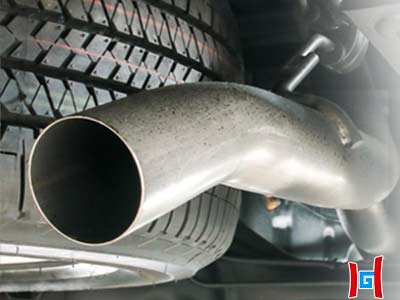
Guia do tubo de escape em aço aluminizado para aplicações automotivas
O tubo de escape de aço aluminizado é amplamente utilizado em sistemas de escape automotivos porque equilibra a resistência ao calor, proteção contra corrosão, conformabilidade, and material cost. Common applications include exhaust pipes, silenciadores, intermediate tubing, and tailpipes, particularly in original equipment manufacturing (OEM) and commercial vehicle production. No entanto, selecting the right tubing requires more than comparing coating types or maximum temperature ratings. Engineers and procurement managers must consider continuous operating temperature, internal condensate corrosion, weld integrity, coating weight, and forming requirements.
What Is Aluminized Steel Exhaust Tube?
Aluminized steel exhaust tube is manufactured from steel protected by an aluminum-based coating. For exhaust applications, the preferred coating is generally Type 1 alumínio-silício (Al-Sim), rather than the commercially pure aluminum coating associated with Type 2 Aço aluminado. The silicon content helps control the coating structure and improve its suitability for hot-dip coating processes. [Por que o silício é adicionado ao revestimento de alumínio Al-11%Si e camada Fe-Al]
| Recurso | Tipo 1 Al-Si Coating | Tipo 2 Revestimento de alumínio |
|---|---|---|
| Coating composition | Liga de alumínio-silício | Predominantly aluminum |
| Primary design objective | Heat resistance and oxidation protection | Atmospheric corrosion protection |
| Aplicações típicas | Tubos de escape, silenciadores, and heating equipment | Telhado, building panels, and industrial enclosures |
| Selection priority | Elevated-temperature service | Atmospheric exposure and surface protection |
These coating types should not be treated as interchangeable. Automotive exhaust components require a coating specification appropriate for their thermal cycles, forming operations, and corrosion environment. The final choice should follow the applicable material standard and the component manufacturer’s requirements. [Óxido de alumínio com estrutura de três camadas de aço aluminizado e camada intermetálica]
How the Coating Protects Exhaust Tubing
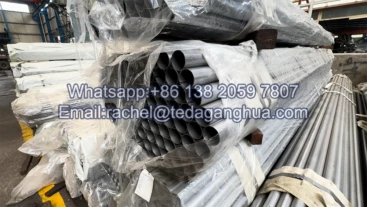
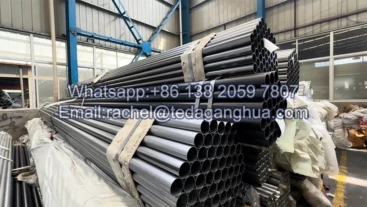
Hot-dip aluminized steel typically has an aluminum-rich outer coating, an iron-aluminum intermetallic transition region, and a steel substrate. The outer surface develops an aluminum oxide film that helps slow further oxidation at elevated temperatures. The metallurgical transition region contributes to coating adhesion, while the steel substrate provides the mechanical strength and formability required for tube fabrication.
The coating offers an important advantage over uncoated carbon steel: it provides a protective surface without requiring the entire tube to be manufactured from an expensive corrosion-resistant alloy. Nevertheless, the coating is not permanent protection under every operating condition. Soldagem, corte, abrasion, severe deformation, and prolonged exposure to corrosive condensate can compromise its effectiveness.
Why Automotive Manufacturers Use Aluminized Exhaust Pipe
Resistência à oxidação em alta temperatura: An aluminum-rich coating forms a protective oxide layer that slows oxidation during appropriate thermal service. This makes aluminized steel useful for exhaust sections exposed to repeated heating and cooling. [Aço inoxidável para extremidades quentes de exaustão e aplicações de alta temperatura]
Corrosion protection at a practical cost: The coating helps protect the steel substrate from atmospheric exposure and certain corrosive environments. Its performance depends on coating quality, temperatura, condensate chemistry, and whether the protective layer remains intact.
Manufacturing flexibility: Properly specified aluminized steel can be slit, roll-formed, resistance-welded, expanded, reduced, and bent into exhaust components. Process settings must account for coating thickness, qualidade de solda, and coating damage during forming.
Competitive material economics: Aluminized steel can provide a practical balance between durability and cost for intermediate pipes, silenciadores, and tailpipes. Stainless steel may be preferable when higher thermal capability, more demanding corrosion resistance, or a longer service-life target justifies the additional material cost.
Aluminized Steel Service Temperature: What Buyers Should Check
Temperature ratings for aluminized steel vary according to the substrate, especificação de revestimento, duração da exposição, atmosphere, and test method. Figures such as 550°C, 593°C (1100° f), and 677°C (1250° f) may appear in technical or commercial descriptions, but they do not necessarily represent equivalent engineering limits. [Temperatura do aço aluminizado 550°C 593°C 677°C explicada]
| Temperature Reference | Interpretation | Procurement Consideration |
|---|---|---|
| Approximately 550°C | A reported reference for limited changes to certain substrate properties | Confirm the actual steel grade, exposure conditions, and test basis. |
| Approximately 593°C (1100° f) | A commonly cited continuous-service reference in some commercial descriptions | Require evidence that the rating applies to the specified tube and duty cycle. |
| Approximately 677°C (1250° f) | A higher-temperature reference that may describe limited exposure or retained properties under specific conditions | Do not interpret this figure as a universal continuous operating limit. |
The melting point of pure aluminum is approximately 660°C (1220° f), but this value alone does not establish the service limit of an aluminum-silicon coating. Alloy composition, intermetallic formation, oxidação, coating degradation, and exposure time all influence performance. Exhaust gas temperature also differs from the actual metal temperature, which changes along the system and during transient operation.
For engineering approval, specify the maximum continuous metal temperature, temperatura máxima, duration and frequency of thermal excursions, and acceptable coating degradation. The manufacturer’s validated service limits should take precedence over a single headline temperature.
Material Selection by Exhaust System Zone
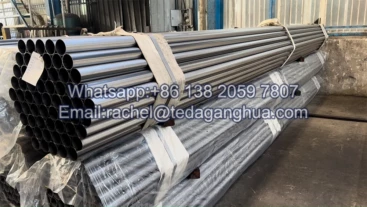
Exhaust systems experience substantial temperature differences from the engine outlet to the tailpipe. Selecting one material for every section can increase cost without necessarily improving system reliability.
| Componente | Potential Material | Selection Priority |
|---|---|---|
| Exhaust manifold and hot-side tubing | Heat-resistant stainless steel or a validated high-temperature alloy | Thermal fatigue, oxidação, and high-temperature strength |
| Catalytic converter housing and high-temperature emission components | Ferritic stainless steel, aluminized ferritic steel, or another qualified material | Temperatura, emissions-system requirements, e resistência à corrosão |
| Intermediate exhaust pipe | Tipo 1 aluminized steel or stainless steel | Thermal cycling, custo, e ambiente de serviço |
| Muffler shell and tailpipe | Aluminized steel or stainless steel | Internal condensate corrosion, sal de estrada, and expected service life |
| Flexible exhaust connector | Application-qualified stainless steel or a specified coated-steel assembly | Vibration fatigue, flexibilidade, and temperature resistance |
Stainless steel is generally a stronger candidate for the hottest sections, but the specific grade must match the actual thermal and mechanical requirements. Tipo 409 stainless steel is commonly used in automotive exhaust systems, enquanto digita 304 may be selected for applications requiring different corrosion or fabrication characteristics. Neither grade should be selected solely by its name without checking the service conditions. [Aluminizado 409 Aço inoxidável para sistemas de exaustão automotiva]
Aço Aluminizado vs.. 409 Stainless Steel vs. 304 Aço inoxidável
Comparing aluminized steel exhaust tube with stainless steel requires consideration of the complete service environment rather than material price alone.
| Factor | Aço Aluminizado | 409 Aço inoxidável | 304 Aço inoxidável |
|---|---|---|---|
| Corrosion mechanism | Depends on coating integrity and substrate protection | Chromium-containing ferritic stainless steel | Chromium-nickel austenitic stainless steel |
| High-temperature suitability | Depends on coating and substrate limits | Common automotive exhaust grade; grade-specific limits apply | Can suit demanding applications, subject to thermal-cycle validation |
| Surface appearance | Can discolor or darken during heating | Can develop heat tint and surface oxidation | Can also develop heat tint and oxidation |
| Relative material cost | Generally economical | Generally intermediate | Generally higher |
| Typical selection | Cost-sensitive pipes and mufflers | Componentes de escapamento automotivo | Applications requiring its specific corrosion and fabrication properties |
A key distinction is that aluminized steel relies on a surface coating, whereas stainless steel obtains its corrosion resistance from the alloy composition throughout the material. Once the aluminized coating is damaged, the exposed carbon steel can corrode. Stainless steel can also suffer localized corrosion, oxidação, and weld-related problems, so it is not immune to failure.
Magnetic testing is not a reliable way to distinguish aluminized steel from stainless steel. Tipo 409 stainless steel is magnetic, and the carbon-steel substrate beneath an aluminized coating is also magnetic. Material identification should rely on documentation, rastreabilidade, and appropriate verification testing.
Internal Condensate Corrosion: A Critical Exhaust-Tube Risk
Exhaust systems can accumulate moisture when combustion gases cool below their dew point. Depending on fuel composition, engine operation, after-treatment equipment, and operating conditions, the resulting condensate may contain acidic or otherwise corrosive species. Silenciadores, low points, joints, and tailpipe sections can be particularly vulnerable when moisture remains trapped.
This creates an important distinction between external appearance and actual component condition. A tube may retain much of its exterior coating while corrosion progresses along the inner wall, at welds, or around joints. Vehicles that frequently make short trips may experience different condensate conditions from vehicles operating for long periods at stable temperatures.
For demanding automotive programs, buyers should define an appropriate exhaust-condensate corrosion test, including the applicable method, exposure conditions, evaluation criteria, and acceptance limits. VDA 230-214 is a relevant method to investigate for exhaust-system condensate corrosion testing; its applicability and current requirements should be verified against the project specification before being placed in a purchase order.
Soldagem, Dobrando, and Fabrication Requirements
Most aluminized exhaust tubing is produced as electric-resistance-welded (Erw) tubing. The manufacturing process and finished product must satisfy the applicable tube specification, tolerâncias dimensionais, requisitos de revestimento, and end-use performance criteria.
Soldagem: Welding heat can damage or alter the coating near the weld and heat-affected zone. The fabrication specification should define whether the coating is locally removed before welding, which welding procedure and filler material are approved, and how exposed areas are protected afterward. Weld appearance alone does not establish corrosion performance.
Dobragem de mandril: Tight-radius bends can cause thinning, enrugando, cross-section distortion, or coating damage. Specify the bend radius, ovality limit, wall-thickness reduction, and post-forming coating acceptance criteria. Mandrel bending can help control tube geometry but does not eliminate every forming risk.
Expansion and reduction: End forming must be compatible with the substrate ductility and coating adhesion. Qualification samples should reproduce the actual tooling, deformação, and dimensional requirements wherever severe forming is involved.
Muffler seams and joints: Mechanical locking, crimping, and overlapping joints can damage the coating or create areas where condensate accumulates. Joint sealing, drenagem, and corrosion-protection procedures should be assessed as part of the complete assembly. [Falha na costura de solda do tubo de escape de aço aluminizado e controle de qualidade]
Cut ends: Cutting may expose uncoated steel at the tube edge. Where exposed edges are vulnerable, specify an appropriate protective treatment or assembly design that limits moisture retention and corrosion propagation.
Passivation should not be confused with removing heat tint or scale from stainless steel. Where stainless components require post-weld restoration, the surface preparation and treatment sequence must be appropriate for the alloy and the applicable procedure.
Standards and Coating Designations
Several standards may be relevant to aluminized exhaust tubing, but they address different aspects of the material. A coating standard for flat steel does not automatically establish that a finished tube meets all exhaust-system requirements.
| Padrão | General Scope | What to Confirm |
|---|---|---|
| ASTM A787/A787M | Electric-resistance-welded metallic-coated carbon-steel mechanical tubing | Applicable edition, coating type, dimensões, and product requirements |
| ASTM A463/A463M | Aluminum-coated steel sheet and strip | Tipo de revestimento, coating designation, and mass requirements |
| EM 10346 | Continuously hot-dip-coated steel flat products | Applicable steel grade, AS coating designation, and ordering conditions |
| JIS G 3314 | Hot-dip aluminum-coated steel sheet and strip | Nota, coating designation, and the requirements of the applicable edition |
| VDA 230-214 | A method associated with corrosion testing of automotive exhaust-system condensates | Method applicability, test conditions, reporting, and acceptance criteria |
[VDA 230-214 Teste de corrosão condensada para materiais de exaustão]
For EN 10346, designations such as AS060, AS080, AS100, AS120, and AS150 indicate nominal coating-mass classes. The stated coating mass generally refers to the total on both sides, expressed in grams per square metre, subject to the applicable standard and ordering requirements. [Bordas cortadas e proteção sacrificial em aço revestido]
[ASTM A787 vs ASTM A463 para tubos de aço aluminizado]
ASTM coating designations use a different convention. Por exemplo, T1-40 is commonly associated with a nominal coating mass of approximately 0.40 oz/ft², equivalent to about 122 g/m² in total. Although this is numerically close to AS120 at 120 g/m², the designations should not be assumed to be technically interchangeable without comparing coating requirements, test methods, and permitted tolerances. [Tipo 1 vs Tipo 2 Guia ASTM A463 de aço revestido de alumínio]
Common Dimensions and Tube Ordering Details
Automotive exhaust tubing is often ordered by outside diameter (DE) and wall thickness rather than by nominal pipe size. Common aftermarket sizes include 1.75, 2.00, 2.25, 2.50, 2.75, 3.00, 3.50, e 4.00 polegadas, although availability depends on the manufacturer and application. A wall thickness of approximately 0.065 polegada, ou 1.65 milímetros, is one commonly encountered size; other dimensions must be confirmed for the intended vehicle or assembly. [OD vs Espessura de Parede vs DN para Tubos de Aço Aluminizado]
| Ordering Item | Recommended Specification |
|---|---|
| Outside diameter | State the exact OD in millimetres or inches. |
| Espessura da parede | Specify nominal thickness and permissible tolerance. |
| Comprimento | Define standard length or cut length and tolerance. |
| Revestimento | Specify Type 1 Al-Si or the exact approved coating designation. |
| Formando | Identify straight tube, mandrel-bent tube, expanded ends, or reduced ends. |
| Inspeção | Define dimensional checks, weld inspection, coating verification, and test reports. |
Por exemplo, an order for a tube with a 2.25-inch outside diameter and a 0.065-inch wall should state those dimensions directly rather than substituting an assumed DN designation. Nominal pipe sizes and actual tube outside diameters follow different sizing conventions, and confusing them can lead to assembly and fit-up problems.
Aluminized Exhaust Tube Procurement Checklist
Before issuing a purchase order, procurement managers should align the following details with the engineering drawing and application requirements:
- Applicable tubing standard and edition, including confirmation of ERW construction where required.
- Approved steel grade and mechanical-property requirements.
- Tipo 1 aluminum-silicon coating designation and applicable coating standard.
- Massa de revestimento, measurement convention, and acceptance tolerance.
- Outside diameter, espessura da parede, comprimento, and dimensional tolerances.
- Maximum continuous metal temperature and allowable peak-temperature exposure.
- Weld procedure, heat-affected-zone protection, and post-weld coating restoration.
- Bending radius, ovality, wall-thickness reduction, and coating adhesion after forming.
- Cut-end protection, seam sealing, drenagem, and internal corrosion requirements.
- Applicable condensate corrosion test method and project-specific acceptance criteria.
- Material test certificate (MTC), rastreabilidade, inspection records, and agreed sampling frequency.
- Packaging, storage, and transport protection against scratches, umidade, and handling damage.
[Especificação do tubo de escape aluminizado e controle de qualidade]
Why Supplier Qualification Matters
For OEM programs, exhaust-component manufacturers, and aftermarket distributors, the best supplier is not necessarily the one offering the lowest initial tube price. Consistency in coating mass, qualidade de solda, dimensional control, material traceability, and delivery performance has a direct influence on downstream fabrication and field reliability.
Tianjin Teda Ganghua supports industrial metal procurement with stainless steel and coated-steel product sourcing, processing coordination, dimensional customization, and material documentation. Buyers developing exhaust-tube specifications can discuss substrate requirements, coating designations, available dimensions, inspection documentation, and application-specific processing needs before confirming an order. For related material options and supply information, visit the aluminized steel product range.
Perguntas frequentes
1. Is aluminized steel exhaust tube suitable for continuous high-temperature service?
It can be suitable when the coating, substrate, and tube construction are qualified for the actual operating conditions. Do not use a generic maximum-temperature figure as the sole selection criterion. Confirm continuous metal temperature, peak exposure, ciclagem térmica, and the manufacturer’s validated limits.
2. What is the difference between Type 1 e tipo 2 Aço aluminado?
Tipo 1 uses an aluminum-silicon coating commonly associated with elevated-temperature applications, including exhaust components. Tipo 2 uses a predominantly aluminum coating primarily associated with atmospheric corrosion protection. They should not be substituted without verifying the applicable material specification and service requirements.
3. Is aluminized steel better than 409 stainless steel for mufflers?
The answer depends on operating temperature, exposição condensada, sal de estrada, expected service life, e orçamento. Aluminized steel can offer an economical balance for suitable applications, enquanto 409 stainless steel provides corrosion resistance through its alloy composition rather than relying on an external coating. Qualification should reflect the complete exhaust environment.
4. Why can aluminized exhaust tubing rust even when the exterior looks intact?
Moisture and corrosive condensate can collect inside mufflers and low points. Corrosion can also initiate at welds, cut edges, and mechanically damaged joints where the coating has been compromised. Internal inspection and application-relevant corrosion testing help identify these risks.
5. Does aluminized exhaust tubing need coating repair after welding?
Welding can damage the coating near the weld and heat-affected zone. The approved fabrication procedure should define local coating removal, controles de soldagem, e qualquer tratamento de proteção contra corrosão pós-soldagem necessário. O método de reparo deve ser adequado à temperatura de serviço e às especificações aplicáveis.