a80 r90 n90: Por que os requisitos de estampagem profunda de calibre fino são relaxados
Para aço de estampagem profunda de espessura fina, os três termos de correção familiares A80, r90 and n90 should not be treated as arbitrary relaxations. Their allowable values are closely connected with specimen geometry, sheet thickness, testing uncertainty and the physical behavior of very thin strip. As thickness decreases, maintaining exactly the same numerical thresholds used for thicker products can become unnecessarily restrictive, even though the material may still provide adequate forming performance.
The key idea: A80, r90 and n90 measure different aspects of sheet-forming behavior. A80 describes elongation, r90 describes plastic strain anisotropy, and n90 describes strain-hardening behavior. For very thin sheet, standards may permit adjusted requirements because measurement sensitivity and specimen geometry become increasingly influential.
1. First Understand What A80, r90 and n90 Measure
Before discussing why requirements can be relaxed, it is important to separate the three parameters.
| Parâmetro | What it measures | Why it matters in forming |
|---|---|---|
| A80 | Percentage elongation after fracture using an 80 mm gauge length | Indicates overall tensile ductility and deformation capacity. |
| r90 | Plastic strain ratio measured in the transverse direction | Relates to resistance against thinning during sheet forming. |
| n90 | Strain-hardening exponent measured in the transverse direction | Indicates how effectively the material hardens during plastic deformation. |
These parameters are therefore not three versions of the same property. A material can have adequate elongation but relatively modest anisotropy, or good anisotropy but a different strain-hardening response.
2. Why Thin Sheet Creates a Special Measurement Problem
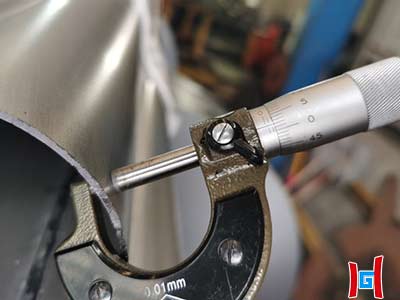
When sheet thickness becomes small, tensile testing becomes more sensitive to specimen preparation, dimensional measurement and localized deformation.
A thinner specimen has a smaller cross-sectional area. Consequently, small differences in thickness measurement, edge quality, surface condition and specimen alignment can have a proportionally greater influence on the calculated result.
The problem is particularly relevant when a specification uses a minimum numerical value. A measured result close to the limit can be affected by test uncertainty even when the material’s practical forming behavior remains suitable for the intended application.
Important distinction: a permitted reduction in a test requirement does not mean that the steel has become “less formable” by definition. It can mean that the standard has recognized the different measurement conditions and statistical variation associated with thin material.
3. Why A80 Can Be Relaxed
A80 is an elongation measurement. It describes the total percentage extension measured over an 80 mm gauge length after fracture.
Elongation is strongly influenced by specimen geometry. When the sheet becomes very thin, the practical dimensions and deformation behavior of the tensile specimen become more difficult to compare directly with those of thicker sheet.
There is another important point: elongation after fracture is not a direct measurement of every forming operation. A deep-drawing process does not deform the sheet uniformly in the same way as a tensile test. Local strain distribution, die radius, blank-holder pressure, friction and strain path all affect the actual forming limit.
Portanto, a slightly lower specified A80 value for a thin product should not automatically be interpreted as an equivalent proportional reduction in every forming capability.
A80 answers one question
It mainly answers: “How much total tensile elongation can this material achieve under the specified tensile test?”
It does not by itself answer: “How deep can this sheet be drawn?”
4. Why r90 Can Be Relaxed
The plastic strain ratio, commonly expressed as r, describes the relationship between width strain and thickness strain during plastic deformation. The r-value is closely related to resistance against thinning and is therefore highly relevant to deep drawing.
For a specimen taken at 90° to the rolling direction, the result is represented as r90. Standards may define minimum or target values for this parameter because sheet anisotropy influences forming behavior.
No entanto, r-value measurement is itself sensitive to the accuracy of width and thickness measurements. With thin sheet, determining the very small thickness changes associated with plastic deformation becomes increasingly demanding.
This is one reason why a standard may establish a different requirement for very thin material. The adjustment recognizes the measurement and material-thickness effects rather than simply declaring that lower r90 is desirable.
Why r90 matters in production
A higher r-value generally indicates greater resistance to thinning under the relevant deformation condition. No entanto, actual forming performance depends on the complete anisotropy profile, not only r90.
For critical deep-drawing work, procurement teams should therefore avoid using one r-value as the sole acceptance criterion. Directional measurements, forming geometry and actual component requirements should be considered together.
5. Why n90 Can Be Relaxed
The strain-hardening exponent n describes how the flow stress increases as plastic strain develops. A higher n-value generally indicates stronger strain hardening over the specified strain range.
Strong strain hardening can help distribute deformation more evenly. Instead of allowing deformation to concentrate immediately in one location, a material with favorable hardening behavior can distribute plastic strain more effectively before localized necking develops.
No entanto, n-value determination requires fitting experimental stress-strain data over a defined strain range. Thin material introduces additional sensitivity to specimen preparation, extensometer accuracy, surface condition and the selected fitting range.
Como resultado, a standard may permit a different n90 requirement for thin products where the measured value has greater relative uncertainty or where the conventional limit would be unnecessarily restrictive.
6. A80, r90 and n90 Are Not Relaxed for the Same Reason
| Parâmetro | Main physical meaning | Thin-sheet issue | Procurement interpretation |
|---|---|---|---|
| A80 | Total tensile ductility | Gauge-length and specimen effects become relatively important. | Do not equate a small reduction in A80 directly with forming failure. |
| r90 | Directional resistance to thinning | Small thickness changes are harder to measure accurately. | Evaluate anisotropy with the actual forming requirement. |
| n90 | Strain-hardening behavior | Calculated value depends on stress-strain measurement and fitting range. | Use it as a forming indicator, not as a standalone acceptance test. |
7. The Thickness Threshold Matters
The important point is that these adjustments are normally connected to defined thickness ranges in the applicable standard. They should not be generalized into a rule such as “all thin sheet is allowed to have lower values.”
When purchasing DX54D or another deep-drawing grade, the buyer should identify the exact edition of the applicable standard and check whether the product thickness falls within a range for which special mechanical or forming-property provisions apply.
This is particularly important when comparing certificates from different production periods. A certificate can appear to show a “failure” if the buyer compares it against a newer table without checking the standard edition, thickness range and test method.
Certificate-checking rule: Always compare the reported A80, r90 and n90 values against the exact standard edition, product thickness and test conditions stated on the certificate.
8. Why “Relaxed” Does Not Mean “Lower Quality”
This is an important distinction for procurement.
Suppose a specification permits a lower minimum value for a very thin product. That does not mean the producer is simply allowed to manufacture a poorer material. Rather, the standard is defining an acceptance window that takes into account the relationship between product thickness, measurement method and expected material behavior.
Quality should therefore be evaluated against the correct standard requirement, not against an arbitrary value copied from a different thickness range.
Por exemplo, rejecting a thin coil because its A80 value is below a requirement intended for a thicker product could create a false nonconformance. Conversely, accepting a material merely because it meets an adjusted minimum would also be inappropriate if the actual component requires stricter forming performance.


9. The Engineering Reason: Test Property vs Forming Limit
One of the most useful distinctions is between a material index and a forming limit.
A80, r90 and n90 are material characterization parameters. They help engineers understand ductility, anisotropy and strain hardening. But an actual stamping or deep-drawing operation involves a much more complex strain path.
- Blank geometry affects material flow.
- Die radius affects local strain concentration.
- Friction changes material draw-in.
- Blank-holder force affects deformation distribution.
- Rolling-direction anisotropy affects local forming behavior.
- Lubrication and tooling condition influence the forming window.
Portanto, a specification adjustment for A80, r90 or n90 should be understood as a standardized material acceptance provision, not as a direct prediction of how a specific component will perform in production.
10. What Procurement Should Check on the MTC
For thin deep-drawing material, the material test certificate should be reviewed systematically.
| MTC item | Check |
|---|---|
| Material designation | Confirm grade, material number and applicable standard edition. |
| Nominal thickness | Confirm which thickness category applies to the acceptance limits. |
| A80 | Compare with the thickness-specific minimum and test method. |
| r90 | Confirm direction, test method and applicable requirement. |
| n90 | Check the specified strain range and applicable acceptance criterion. |
| Coating condition | For coated products, verify coating designation and coating-mass requirements separately. |
11. Teda Ganghua: Thin-Gauge Material Requires Specification Discipline
Teda Ganghua can support procurement teams that need thin-gauge coated steel by separating the grau de material, sistema de revestimento, thickness category e formando requisitos. This is particularly useful when a project uses deep-drawing material for fabricated tubing or formed components.
For buyers sourcing tubos de aço aluminizados, the inquiry can specify the substrate grade, coating designation, espessura da parede, diâmetro externo, tube-forming requirements and service conditions. Where the material is subsequently formed from thin strip, the applicable thickness-dependent mechanical requirements can also be reviewed against the purchase specification.
For technical inquiries: provide the exact standard edition, espessura nominal, grade, coating designation and intended forming operation. This allows A80, r90 and n90 requirements to be interpreted against the correct product category rather than copied from a thicker specification.
12. Final Takeaway
The reason thin-gauge requirements for A80, r90 and n90 can be relaxed is not simply that thinner steel is permitted to have inferior properties. Each parameter is measured through a specific test methodology, and the influence of specimen dimensions, measurement accuracy, thickness and statistical variation becomes more significant as the product becomes thinner.
A80 characterizes tensile elongation, r90 characterizes directional plastic anisotropy, e n90 characterizes strain hardening. They provide complementary information about forming behavior, but none of them alone defines the forming limit of a finished component.
The correct procurement approach is therefore to check the exact standard edition + thickness range + test method + reported value. Once those four elements are aligned, an apparently “relaxed” requirement can be understood as a deliberate standard provision rather than a reduction in product quality.
Perguntas frequentes
What does A80 mean?
A80 is the percentage elongation after fracture measured using an 80 mm gauge length. It is primarily an indicator of tensile ductility.
What does r90 tell engineers?
r90 describes the plastic strain ratio measured in the transverse direction of the sheet. It is useful for evaluating anisotropic forming behavior and resistance to thinning.
Why can n90 have a lower requirement for thin material?
n90 is calculated from stress-strain behavior over a defined strain range. Thin specimens can have greater relative sensitivity to testing and calculation conditions, so the applicable standard may establish thickness-dependent requirements.
Does a relaxed A80, r90 or n90 value mean the material is poor quality?
Não. The material should be judged against the requirement applicable to its exact thickness, standard edition and test method. A thickness-specific allowance is not automatically a quality defect.
Can A80, r90 and n90 predict whether my part will pass deep drawing?
They are useful forming indicators, but they cannot independently predict the forming limit of a particular component. Tool geometry, friction, blank-holder force, strain path and material anisotropy also influence production results.