OD เทียบกับความหนาของผนังเทียบกับ DN สำหรับท่อเหล็กอลูมิไนซ์
เมื่อซื้อท่อเหล็กสำหรับระบบไอเสียรถยนต์, ท่อไอเสียอุตสาหกรรม, หรืออุปกรณ์ที่มีอุณหภูมิสูง, one of the most common specification misunderstandings involves OD, ความหนาของผนัง, and DN. Although these terms are frequently used together in piping and tubing procurement, they do not describe the same dimensional characteristics. Confusing them can lead to incorrect material selection, incompatible connections, dimensional deviations, and unnecessary fabrication costs.
For exhaust tubing, the outside diameter (ของ) and wall thickness are usually the primary purchasing dimensions. ดีเอ็น, or nominal diameter, is a nominal designation commonly used in piping systems rather than an exact measurement of the tube’s physical outside diameter. Understanding this distinction is particularly important when sourcing aluminized steel tubes, where dimensional accuracy affects bending, การเชื่อม, ความเข้ากันได้ที่เหมาะสม, and final assembly.
1. ของ, ความหนาของผนัง, and DN: Three Different Concepts
Before preparing a purchase order, buyers should understand what each dimensional term represents.
1.1 เส้นผ่านศูนย์กลางภายนอก (ของ)
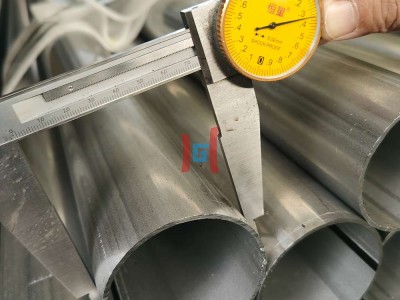
OD refers to the actual external diameter of a tube, measured across its outer surface. It is commonly expressed in millimeters or inches.
For exhaust tubing, OD determines how the tube fits into connecting pipes, clamps, flanges, bends, และส่วนประกอบอื่นๆ. It is therefore a critical dimension for assembly compatibility.
1.2 ความหนาของผนัง (WT)
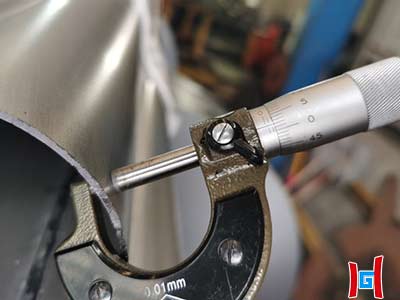
Wall thickness refers to the thickness of the tube wall, measured between its internal and external surfaces. It affects mechanical strength, น้ำหนัก, internal flow area, ประสิทธิภาพการขึ้นรูป, and heat transfer.
For a tube with a uniform wall thickness, the approximate inside diameter can be calculated as:
Inside Diameter (บัตรประจำตัวประชาชน) = OD − 2 × Wall Thickness
All dimensions must use the same unit.
ตัวอย่างเช่น, a tube with an OD of 60.3 mm and a wall thickness of 2.0 mm has an approximate ID of 56.3 มม. This calculation assumes uniform wall thickness and does not account for manufacturing tolerances or local weld-seam geometry.
1.3 Nominal Diameter (ดีเอ็น)
DN is a nominal size designation used to identify components in piping systems. It is not necessarily equal to the measured inside diameter or outside diameter.
DN is useful for identifying compatible nominal pipe sizes and fittings within a specified dimensional system. อย่างไรก็ตาม, it should not be used as a substitute for the actual OD and wall thickness when ordering exhaust tubing.
| Dimension | Meaning | Main Purchasing Purpose |
|---|---|---|
| ของ | Actual outside diameter | Connection and fitting compatibility |
| WT | Actual or specified wall thickness | ความแข็งแกร่ง, น้ำหนัก, and internal diameter |
| บัตรประจำตัวประชาชน | Actual inside diameter | Flow area and internal clearance |
| ดีเอ็น | Nominal diameter designation | Piping system identification |
2. Why DN Cannot Be Directly Converted into OD
A common procurement mistake is assuming that DN50 means a tube with an outside diameter of exactly 50 มม. This assumption is incorrect.
In many piping standards, DN50 corresponds to a nominal pipe size whose actual outside diameter is 60.3 มม. The inside diameter then varies according to the specified wall thickness or pipe schedule.
This means that two pipes with the same DN can have different internal diameters while maintaining the same standardized outside diameter within a given dimensional system.
For exhaust tubing, the situation is even more important because many automotive and industrial tube products use direct OD specifications rather than DN designations.
| Nominal Size | Common NPS Equivalent | Standardized Outside Diameter |
|---|---|---|
| DN25 | 1 ใน. | 33.4 มม |
| DN32 | 1¼ in. | 42.2 มม |
| DN40 | 1½ in. | 48.3 มม |
| DN50 | 2 ใน. | 60.3 มม |
| DN65 | 2½ in. | 73.0 มม |
| DN80 | 3 ใน. | 88.9 มม |
| DN100 | 4 ใน. | 114.3 มม |
Important: These values are common ASME NPS outside diameters paired with corresponding DN designations. They are reference values, not universal conversion rules for every tube or piping standard. Always confirm the applicable dimensional standard before ordering.
3. Why Exhaust Tubes Are Usually Specified by OD × Wall Thickness
Unlike conventional process piping, automotive exhaust systems frequently rely on precise physical dimensions to ensure that individual components fit together correctly.
For this reason, manufacturers commonly specify exhaust tubes using an OD × WT format, followed by the required length and material designation.
3.1 Connection Compatibility
Exhaust pipes connect to mufflers, catalytic converters, flexible connectors, flanges, และส่วนประกอบอื่นๆ. Their outside diameters must match the connection design.
A small OD deviation can create installation difficulties, loose connections, or excessive interference during assembly. ดังนั้น, OD tolerance is often more important than the nominal size label.
3.2 Internal Flow Area
Wall thickness determines the internal diameter when OD remains constant. A thicker wall reduces the available flow area, while a thinner wall increases it.
For exhaust systems, internal geometry can influence gas velocity, การสูญเสียความดัน, and system performance. Engineers should evaluate the complete exhaust design rather than selecting wall thickness solely according to material weight.
3.3 Weight and Material Consumption
For a given steel density and tube length, increasing wall thickness increases material consumption and component weight.
The theoretical mass per unit length of a circular steel tube can be estimated using:
Mass per meter = 0.02466 × WT × (OD − WT) × ρ / 7.85
OD and WT are in millimeters, and ρ is the material density in g/cm³. The result is approximately kg/m. The factor is normalized to a steel density of 7.85 g/cm³.
For coated tubing, the actual mass also depends on the coating contribution, substrate density, and dimensional measurement basis. The formula is an engineering estimate rather than a substitute for weighing the finished product.
4. OD × Wall Thickness Examples for Exhaust Tube Procurement
The following examples illustrate how the same outside diameter can be combined with different wall thicknesses to create different internal dimensions.
| เส้นผ่านศูนย์กลางภายนอก | ความหนาของผนัง | Calculated Inside Diameter | Typical Consideration |
|---|---|---|---|
| 38.1 มม | 1.2 มม | 35.7 มม | Lightweight exhaust components |
| 42.4 มม | 1.5 มม | 39.4 มม | Small exhaust assemblies |
| 50.8 มม | 1.5 มม | 47.8 มม | Automotive exhaust tubing |
| 60.3 มม | 2.0 มม | 56.3 มม | Larger exhaust connections |
| 76.2 มม | 2.0 มม | 72.2 มม | Industrial exhaust applications |
| 89.0 มม | 2.5 มม | 84.0 มม | Larger fabricated tube assemblies |
These are illustrative dimensional combinations rather than mandatory standard sizes. Actual availability and suitability depend on the tube manufacturing specification, แอปพลิเคชัน, and purchaser requirements.
5. Wall Thickness Tolerance: Why the Nominal Value Is Not the Whole Story
When ordering coated exhaust tubing, specifying a nominal wall thickness is not sufficient. Buyers should also define the acceptable thickness tolerance and clarify whether the measurement refers to the total coated wall or the steel substrate alone.
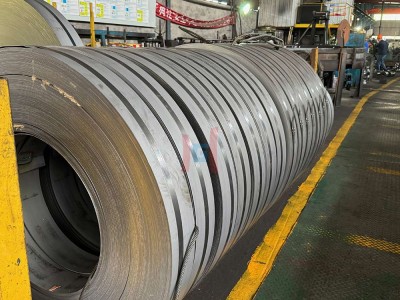
This distinction is particularly important for precoated steel strips used to manufacture welded tubing. The original coated sheet thickness, coating contribution, forming deformation, and weld-seam geometry can all affect the finished tube dimensions.
5.1 Total Wall Thickness vs. Base Steel Thickness
For precoated materials, the ordered thickness may represent the total thickness of the coated sheet rather than the thickness of the uncoated steel substrate.
ตัวอย่างเช่น, a purchasing specification that simply states 1.5 mm may lead to different interpretations if the supplier and buyer do not agree on the measurement basis.
The purchase order should therefore identify whether the requirement applies to the total coated thickness or the base metal thickness, together with the applicable measurement method.
5.2 OD Tolerance and Roundness
OD accuracy is essential for exhaust pipe connections. In addition to the average outside diameter, engineers may need to control ovality, straightness, and local deformation.
Tube bending and sizing operations can affect roundness. Excessive ovality may cause problems when inserting pipes into connectors or fitting exhaust components together.
5.3 Weld Seam and Local Thickness
Electric-resistance-welded tubes contain a longitudinal weld seam. Depending on the manufacturing process, local weld geometry may differ from the surrounding tube wall.
Where the application requires close dimensional control, the inspection plan should identify the measurement locations and acceptance criteria for the weld region.
6. How to Write a Correct Exhaust Tube Purchase Specification
A complete purchasing description should prioritize actual dimensions instead of relying on a nominal diameter alone.
Recommended specification format
ผลิตภัณฑ์: Aluminum-coated ERW steel exhaust tube
Dimensions: OD × WT × Length
วัสดุ: Specified steel grade
การเคลือบ: Aluminum or aluminum-silicon coating designation
Manufacturing standard: Applicable tubing standard
Surface requirements: Coating integrity, scratches, and visible defects
Dimensional tolerance: ของ, ความหนาของผนัง, ความยาว, and ovality where required
Inspection: Dimensional, เชื่อม, การเคลือบ, and material documentation requirements
ตัวอย่างเช่น, instead of writing only DN50 aluminized exhaust tube, a clearer inquiry would specify the required actual outside diameter, ความหนาของผนัง, ความยาว, coating designation, เกรดวัสดุ, and manufacturing standard.
If a DN designation is also necessary for connection compatibility, it should be included as a supplementary reference rather than replacing the physical dimensions.
7. เทดา กังฮวา: Supporting Accurate Aluminized Tube Specifications
Dimensional accuracy is essential when sourcing coated steel tubing for exhaust systems, อุปกรณ์อุตสาหกรรม, and fabricated components. A mismatch between nominal pipe size and actual tube dimensions can affect connection compatibility, bending operations, welding quality, and final assembly efficiency.
Teda Ganghua supports industrial buyers with metal material sourcing, specification confirmation, dimensional customization, and quality inspection coordination. When developing an aluminized tube purchasing plan, procurement managers should provide the actual OD, ความหนาของผนัง, ความยาว, ข้อกำหนดการเคลือบ, and intended application rather than relying exclusively on DN designations.
For projects involving ท่อเหล็กอลูมิไนซ์, Teda Ganghua can assist buyers in reviewing dimensional requirements and coordinating suitable material solutions according to project specifications.
With export experience since 2006, Teda Ganghua focuses on specification communication, material traceability, and inspection coordination to help international customers reduce dimensional misunderstandings during procurement.
For a more accurate inquiry, buyers can provide technical drawings or a dimensional schedule showing OD, ความหนาของผนัง, ความยาว, tolerance requirements, and connection details. This makes it easier to evaluate whether the proposed tubing matches the intended assembly.
8. บทสรุป: Always Specify Actual OD and Wall Thickness
ของ, ความหนาของผนัง, and DN serve different purposes in tube and piping specifications. OD defines the external dimension, wall thickness determines the tube wall and influences the internal diameter, while DN provides a nominal size designation for piping system identification.
For exhaust tubing, the actual OD × wall thickness format is generally more useful for procurement and manufacturing because it directly describes the physical dimensions required for connection, การขึ้นรูป, and assembly.
DN can still be useful when coordinating with standardized piping components, but it should never replace the actual dimensional requirements. A complete purchase specification should include OD, ความหนาของผนัง, ความยาว, เกรดวัสดุ, coating designation, applicable manufacturing standard, and dimensional tolerances.
By clearly defining these parameters, buyers can reduce specification errors, improve dimensional compatibility, and achieve more consistent quality in coated exhaust tube procurement.
คำถามที่พบบ่อย
1. Is DN50 equal to an outside diameter of 50 มม?
เลขที่. DN50 is a nominal diameter designation. In common ASME NPS piping dimensions, DN50 corresponds to NPS 2, with an actual outside diameter of 60.3 มม. The applicable dimensional standard must always be confirmed.
2. Why is OD × wall thickness preferred for exhaust tube orders?
Because exhaust systems often require precise physical dimensions for connecting pipes, ท่อไอเสีย, flanges, และส่วนประกอบอื่นๆ. OD and wall thickness provide direct dimensional information for manufacturing and assembly.
3. How do you calculate the inside diameter of a steel tube?
For a uniform circular tube, subtract twice the wall thickness from the outside diameter: ID = OD − 2 × WT. The result is an approximate nominal geometric value before manufacturing tolerances and local weld effects are considered.
4. Does wall thickness include the aluminum coating?
The answer depends on the product specification and measurement basis. For precoated steel tubing, the total coated wall and base steel thickness should be clearly distinguished in the purchase order to avoid different interpretations.
5. What dimensions should buyers provide when ordering aluminized exhaust tubes?
Buyers should provide the actual outside diameter, ความหนาของผนัง, ความยาวท่อ, ความคลาดเคลื่อนมิติ, เกรดวัสดุ, coating designation, manufacturing standard, และข้อกำหนดของแอปพลิเคชัน. ภาพวาดทางเทคนิคยังมีประโยชน์เมื่อท่อต้องพอดีกับส่วนประกอบไอเสียที่มีอยู่.