บทบาทของซิลิคอนในเหล็กอลูมิไนซ์: ทำไมซิลิคอนถึง 9–10% จึงมีความสำคัญ
ซิลิคอนเป็นหนึ่งในโลหะผสมที่เล็กที่สุดในเหล็กอลูมิไนซ์แบบจุ่มร้อน, yet it has one of the greatest influences on coating performance. Although the aluminum-silicon bath used for Type 1 aluminized steel typically contains only 9–10% silicon, this carefully controlled addition fundamentally changes the metallurgical reaction between molten aluminum and steel. ปราศจากซิลิคอน, the coating would become excessively brittle, difficult to process, and far less reliable in demanding industrial applications.
From automotive exhaust tubing to industrial furnace components, the addition of silicon enables aluminized steel to achieve the unique balance of heat resistance, การป้องกันการกัดกร่อน, การยึดเกาะของการเคลือบ, and formability that modern industries require.
Why Is Silicon Added to Hot-Dip Aluminizing?
Pure aluminum reacts aggressively with iron during hot-dip coating. As steel enters molten aluminum, iron atoms rapidly diffuse into the coating while aluminum diffuses toward the steel substrate. Without proper control, thick iron-aluminum intermetallic compounds grow rapidly, creating a brittle interface.
Adding approximately 9–10% silicon slows this reaction and stabilizes the growth of the alloy layer, resulting in a thinner, more uniform metallurgical bond.
| Bath Composition | Main Purpose |
|---|---|
| อลูมิเนียม (~90%) | Provides corrosion resistance and heat reflection |
| ซิลิคอน (9–10%) | Controls alloy layer growth and improves coating quality |
| Trace Iron | Forms stable metallurgical diffusion layer |
The Metallurgical Role of Silicon
Silicon changes the diffusion behavior between iron and aluminum during immersion in the molten bath.
Its primary metallurgical functions include:
- Reducing the growth rate of Fe-Al intermetallic compounds.
- Improving coating ductility.
- Reducing internal stress during cooling.
- Enhancing coating adhesion.
- Producing a smoother coating surface.
- Improving forming performance after coating.
Instead of allowing thick brittle layers to develop, silicon encourages the formation of a controlled diffusion interface that maintains both strength and flexibility.
What Happens Without Silicon?
If pure aluminum is used without silicon, the reaction between molten aluminum and steel becomes much more aggressive.
| Without Silicon | With 9–10% Silicon |
|---|---|
| Rapid Fe-Al alloy growth | Controlled alloy layer thickness |
| Thick brittle intermetallic layer | Thin, stable diffusion layer |
| Higher cracking risk | Improved ductility |
| Poor forming performance | Better bending capability |
| Lower coating adhesion reliability | Excellent metallurgical bonding |
| Less stable welding behavior | Improved fabrication performance |
This comparison demonstrates why silicon is considered essential rather than optional in Type 1 aluminized steel production.
How Silicon Controls Intermetallic Compound Growth
During hot-dip aluminizing, several iron-aluminum compounds naturally form between the coating and the steel substrate, including Fe2อัล5 and FeAl3.
These compounds provide the metallurgical bond, but excessive growth makes the coating brittle.
Silicon modifies the diffusion kinetics by:
- Slowing iron atom migration.
- Reducing aluminum penetration into the steel.
- Refining intermetallic crystal morphology.
- Producing a more uniform interface.
The result is a coating that remains firmly bonded while maintaining sufficient toughness for downstream processing.
Improved Formability After Coating
One of the greatest benefits of silicon is its contribution to post-coating fabrication.
Many aluminized products undergo:
- การขึ้นรูปม้วน
- การงอ
- การวาดภาพลึก
- Tube forming
- การตอก
A brittle coating would crack during these operations. The optimized aluminum-silicon coating maintains sufficient flexibility to tolerate deformation while preserving corrosion protection.
Why Silicon Improves Automotive Exhaust Performance
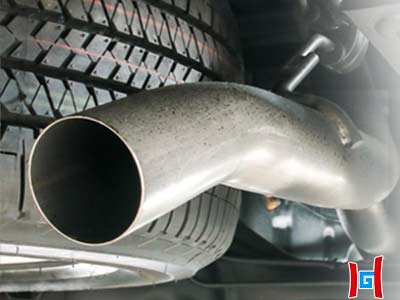
Automotive exhaust systems operate under continuous thermal cycling. Pipes repeatedly expand and contract as temperatures rise from ambient conditions to several hundred degrees Celsius.
The silicon-containing coating offers several advantages:
- Reduced thermal cracking.
- Stable adhesion during repeated heating.
- ต้านทานการเกิดออกซิเดชันได้ดีเยี่ยม.
- Long service life under cyclic thermal loading.
These characteristics explain why aluminum-silicon coatings have become the industry standard for many exhaust applications.
Influence on Corrosion Resistance
Although aluminum provides the primary corrosion protection, silicon indirectly improves corrosion performance by producing a more uniform coating structure.
A stable alloy layer reduces localized coating defects that could become initiation points for corrosion.
Benefits include:
- More consistent coating thickness.
- Improved coating continuity.
- Reduced micro-cracking.
- Better long-term durability.
Heat Resistance Benefits
พิมพ์ 1 aluminized steel is widely selected for elevated-temperature applications because the aluminum-silicon coating remains stable under continuous heating.
| Performance Characteristic | Benefit of Silicon Addition |
|---|---|
| High-temperature oxidation | Improves coating stability |
| Thermal cycling | Reduces cracking tendency |
| Coating adhesion | Maintains metallurgical bond |
| Surface integrity | Produces smoother coating finish |


Quality Indicators for an Optimized Al-Si Coating
Manufacturers typically evaluate several indicators to confirm proper silicon-controlled coating formation:
- ความหนาของการเคลือบสม่ำเสมอ.
- Consistent diffusion layer.
- Smooth surface appearance.
- Good bend test performance.
- Excellent adhesion after forming.
- Minimal coating cracking.
Industrial Applications That Depend on the Al-Si Coating
- ท่อไอเสียรถยนต์
- ท่อเตาอุตสาหกรรม
- เครื่องแลกเปลี่ยนความร้อน
- Boiler systems
- HVAC ventilation tubing
- อุปกรณ์อบแห้งทางการเกษตร
- Industrial chimneys
Teda Ganghua Aluminized Steel Tube Solutions
Teda Ganghua manufactures aluminized steel tube solutions using carefully controlled aluminum-silicon coating technology to achieve excellent heat resistance, การป้องกันการกัดกร่อน, การยึดเกาะของการเคลือบ, and fabrication performance. Strict process control throughout hot-dip aluminizing ensures stable coating quality suitable for automotive, เครื่องทำความร้อนอุตสาหกรรม, เครื่องปรับอากาศ, agricultural equipment, and heavy manufacturing applications.
Whether customers require standard specifications or customized processing, Teda Ganghua provides technical support to help select the appropriate aluminized steel products for long-term operational reliability.
Learn more about our
ท่อเหล็กอลูมิไนซ์
for demanding industrial applications.
คำถามที่พบบ่อย
Why is 9–10% silicon commonly used?
This composition effectively controls the growth of brittle iron-aluminum intermetallic compounds while maintaining excellent coating adhesion and heat resistance.
Can aluminized steel be produced without silicon?
It can, but coatings without silicon generally develop thicker and more brittle alloy layers, reducing forming performance and long-term durability.
Does silicon improve corrosion resistance directly?
Silicon mainly improves coating structure and stability, ช่วยให้ชั้นอลูมิเนียมสามารถป้องกันการกัดกร่อนได้สม่ำเสมอมากขึ้นเมื่อเวลาผ่านไป.
เหตุใดซิลิคอนจึงมีความสำคัญต่อระบบไอเสีย?
ช่วยให้สารเคลือบทนต่อรอบการให้ความร้อนและความเย็นซ้ำๆ โดยไม่เกิดการแตกร้าวหรือสูญเสียการยึดเกาะมากเกินไป.
ปริมาณซิลิกอนเท่ากันสำหรับเหล็กอลูมิไนซ์ทั้งหมดหรือไม่?
พิมพ์ 1 โดยทั่วไปเหล็กอลูมิไนซ์จะมีซิลิคอนประมาณ 8–11%, ในขณะที่พิมพ์ 2 สารเคลือบส่วนใหญ่เป็นอะลูมิเนียมบริสุทธิ์ และได้รับการออกแบบสำหรับสภาพแวดล้อมการบริการที่แตกต่างกัน.