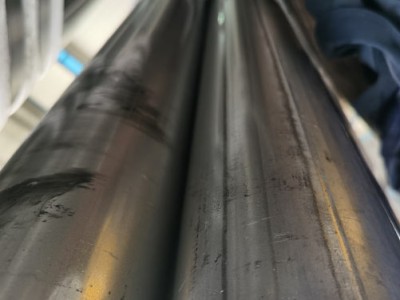
Ngăn chặn rỉ sét ống thép Aluminized tại các mối hàn và các cạnh cắt
Các đường hàn và mép cắt thường là vị trí đầu tiên xuất hiện rỉ sét trên ống thép tráng nhôm, even when the original surface coating remains intact. The reason is that welding, cắt, grinding, and forming can expose the underlying steel or alter the protective aluminum-silicon coating. Once the steel substrate becomes exposed, độ ẩm, oxygen, muối, and process residues can initiate localized corrosion. Preventing premature rust therefore requires more than applying a repair coating: manufacturers must control edge preparation, weld finishing, surface cleaning, coating restoration, and final inspection as one coordinated process.
1. Why Weld Seams and Cut Edges Rust First
Aluminized steel typically uses an aluminum-silicon coating to improve oxidation resistance and provide corrosion protection under suitable service conditions. The coating protects the steel through a combination of barrier protection and the behavior of the aluminum-rich surface. Tuy nhiên, its performance depends on coating continuity, the surrounding environment, and the condition of processed areas.
Four common causes of localized rust
- Exposed steel: Cutting or grinding removes the coating and exposes the substrate.
- Heat-affected coating: Welding heat can damage or transform the coating around the joint.
- Mechanical damage: hình thành, handling, and weld-flash removal can scratch or remove the protective layer.
- Contamination and moisture retention: Salts, oils, welding residues, and trapped moisture can accelerate corrosion at vulnerable locations.
The first visible rust does not necessarily mean that the entire coating system has failed. Localized damage may be responsible, especially where fabrication has interrupted the original protective surface. Nevertheless, rust at a seam or edge should be investigated to determine whether the problem is limited to the coating or extends to the underlying steel.
2. Why Cut Edges Need Special Attention
When a coated tube is cut to length, the cutting operation exposes the steel cross-section. Unlike the original external surface, this newly exposed edge does not retain the full factory-applied coating. The severity of corrosion depends on the cut geometry, steel thickness, coating characteristics, environmental exposure, and the effectiveness of any subsequent protection.
Three edge conditions to distinguish
| Edge condition | Main corrosion concern | Recommended control |
|---|---|---|
| Freshly cut edge | Exposed steel can rust when moisture and oxygen reach the surface. | Remove burrs, clean the edge, and apply a compatible protective treatment where required. |
| Ground or deburred edge | Grinding may enlarge the uncoated area or thin the tube wall. | Use controlled material removal and inspect the remaining wall thickness. |
| Damaged edge in service | Corrosion may spread beneath damaged coating or into adjacent steel. | Assess the affected area, remove corrosion products, and restore protection according to the repair specification. |
Edge protection is particularly important where cut ends remain exposed to rain, sự ngưng tụ, road salts, industrial chemicals, or frequent wetting and drying. For hollow tubes, open ends and internal surfaces may also collect water or contaminants. Where drainage is inadequate, even a sound exterior coating may not prevent internal corrosion.
3. Why Weld Seams Can Become Corrosion Hotspots
Welding introduces several potential sources of coating damage. Depending on the welding process, the joint may experience intense local heating, coating removal, molten-metal contact, quá trình oxy hóa, and mechanical finishing. These effects can leave the weld and surrounding heat-affected region less protected than the original surface.
- Coating removal before welding: The preparation zone may expose bare steel, creating an area that needs post-weld protection.
- Heat-related damage: High local temperatures can change the coating structure and oxidize nearby surfaces.
- Weld spatter and slag: Residues may obstruct repair coating adhesion or create local surface defects if not removed.
- Weld-flash removal: Excessive grinding can remove additional coating and reduce the remaining wall thickness.
- Incomplete restoration: A visually acceptable weld may still have inadequate corrosion protection if the surrounding coating is not repaired.
The correct approach is to evaluate weld integrity and coating integrity separately. A weld may satisfy its mechanical acceptance criteria while the adjacent surface still requires corrosion protection. Conversely, an attractive repair coating cannot compensate for an unacceptable weld defect.
4. A Complete Corrosion-Repair Process for Aluminized Tubes
A dependable repair procedure should define each operation, its acceptance criteria, and the inspection records required before release. The following sequence is a practical framework that should be adapted to the coating system and operating environment.
Bước chân 1 — Inspect and map the damage
Identify exposed steel, damaged coating, rust, weld spatter, grinding marks, and areas where water may accumulate. Record the location and approximate extent of each defect.
Bước chân 2 — Remove loose material and corrosion products
Use an appropriate mechanical or other approved cleaning method to remove loose rust, tỉ lệ, spatter, and unsound coating. Avoid aggressive grinding that unnecessarily reduces the tube wall or enlarges the damaged area.
Bước chân 3 — Prepare and clean the surface
Loại bỏ dầu, dầu mỡ, muối, and other contaminants using compatible methods. Ensure the surface condition meets the repair material manufacturer’s requirements, including any specified cleanliness and roughness.
Bước chân 4 — Apply a compatible repair system
Select a metallic coating repair process or a qualified protective coating system suited to the original coating, exposure conditions, and operating temperature. Follow the specified application thickness and curing requirements.
Bước chân 5 — Inspect and document the repair
Check coverage, adhesion where specified, dry-film thickness where applicable, and any required visual or performance criteria. Record repairs and confirm that the treated area is suitable for the intended service.
Cleaning and preparation must be completed before applying the repair material. Applying a coating over loose rust, oily residue, or moisture can cause poor adhesion and premature failure. If corrosion has caused significant pitting, thủng, or wall-thickness loss, evaluate the tube’s structural suitability before deciding whether a surface repair is acceptable.
5. Which Repair Coating Should Be Used?
No single repair product is appropriate for every aluminized steel application. The selection should reflect the original coating composition, service temperature, phơi nhiễm ăn mòn, repair location, và tuổi thọ sử dụng cần thiết.
| Repair option | Potential application | Important limitation |
|---|---|---|
| Thermal metal spraying | Metallic restoration of appropriately prepared areas when the specified process is suitable. | Requires controlled surface preparation, equipment, application parameters, and quality verification. |
| Aluminum-rich repair coating | Selected repair applications where the product is compatible with the service environment. | Thành phần, độ bám dính, temperature resistance, and specified performance must be verified. |
| Zinc-rich protective coating | Certain exposed-steel repairs where zinc-based protection is approved. | It does not automatically reproduce the behavior or high-temperature performance of an aluminum-silicon coating. |
| Qualified organic coating system | Applications where a compatible barrier coating meets the exposure and temperature requirements. | Temperature limits, curing, edge coverage, and long-term adhesion must be considered. |
The original aluminum-silicon coating is not equivalent to a generic paint film. In particular, a repair coating intended for ambient-temperature outdoor exposure may be unsuitable for exhaust components, Trao đổi nhiệt, or other applications operating at elevated temperatures. Confirm the repair system’s service limits before production use.
6. How to Prevent Rust Instead of Repeatedly Repairing It
Effective corrosion prevention begins before the tube is cut or welded. Process planning should minimize unnecessary coating damage, keep exposed steel clean, and ensure that repairs can be applied and inspected consistently.
- Optimize cutting: Select a suitable cutting method and control heat input, burr formation, and damage to adjacent surfaces.
- Control welding: Use a qualified welding procedure and remove contaminants and spatter before restoring the coating.
- Limit grinding: Remove only the material necessary to achieve the specified joint and surface condition.
- Protect exposed ends: Apply the specified edge treatment or end protection where required by the application.
- Design for drainage: Avoid water traps and inaccessible cavities where the design permits, and address internal coating damage.
- Control handling and storage: Prevent abrasion, prolonged wet storage, and contamination by corrosive residues.
- Inspect repaired areas: Define measurable acceptance criteria rather than relying on visual appearance alone.
For applications involving frequent thermal cycling, the repair system should also be assessed for differential thermal expansion, coating cracking, and adhesion under operating conditions. A repair that performs well at room temperature may not remain intact during repeated heating and cooling.
7. Selecting Aluminized Steel Tubes for Fabrication
When purchasing tubes for welded or cut-to-length applications, corrosion performance should be considered alongside dimensions, lớp vật liệu, đặc điểm kỹ thuật lớp phủ, và yêu cầu chế tạo. Buyers should state whether the tubes will be bent, hàn, mechanically finished, or exposed to elevated temperatures. These details help establish whether the original coating and the planned repair procedure are suitable for the intended service.
Teda Ganghua supports procurement discussions for ống thép tráng nhôm, helping buyers clarify dimensional requirements, thông số kỹ thuật lớp phủ, and documentation expectations before confirming an order. Providing the application environment and planned processing operations at the inquiry stage can help identify potential coating-related issues before fabrication begins.
A useful technical inquiry should include the following information:
- Steel grade and applicable product standard.
- Outside diameter, độ dày của tường, chiều dài, and dimensional tolerances.
- Coating type and specified coating requirements.
- Cắt, hàn, uốn cong, and post-processing methods.
- Operating temperature, tiếp xúc với độ ẩm, and corrosive substances in the service environment.
- Inspection requirements and any approved post-weld or cut-edge repair system.
The most reliable approach is to treat the coating as part of the complete fabrication system. Preventing premature rust requires control over the original material, processing damage, surface preparation, repair compatibility, and final inspection—not simply adding another layer of paint after corrosion appears.
Câu hỏi thường gặp
1. Why do cut edges rust before the rest of an aluminized steel tube?
Cutting exposes the steel substrate and interrupts the original coating. When moisture and oxygen reach the exposed edge, corrosion can begin before the intact coated surface shows visible deterioration.
2. Can rust at a weld seam be repaired by simply applying paint?
Not reliably. Loose rust, tỉ lệ, dầu, and unsound coating must first be removed. The repair material must then be compatible with the original coating and the operating environment, with application and inspection performed according to the specified procedure.
3. Is zinc-rich paint suitable for repairing an aluminum-silicon coating?
It may be acceptable for certain exposed-steel repairs, but it is not automatically equivalent to the original metallic coating. Verify compatibility, độ bám dính, nhiệt độ hoạt động, and the project’s corrosion-protection requirements before use.
4. How can corrosion inside a tube be prevented?
Specify suitable internal coating protection, minimize moisture retention, provide drainage where appropriate, and evaluate whether welding or finishing damages the internal surface. Internal areas that cannot be inspected or repaired require particular attention during design and process qualification.
5. When should a corroded tube be replaced rather than repaired?
Replacement should be considered when corrosion causes unacceptable wall-thickness loss, thủng, structural damage, or defects that cannot be restored to the required acceptance criteria. Quyết định phải dựa trên đánh giá kỹ thuật và các yêu cầu dịch vụ hiện hành.