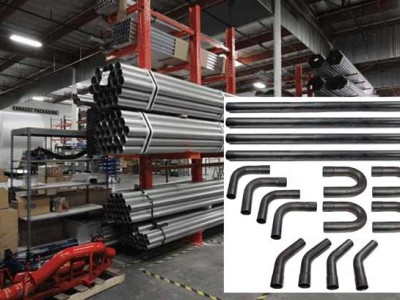
لماذا يفضل مصنعو المعدات الأصلية 409 الفولاذ المقاوم للصدأ لأنظمة العادم
لماذا يفضل مصنعو المعدات الأصلية 409 الفولاذ المقاوم للصدأ للعديد من أنظمة عادم المصانع? الجواب ليس مجرد التكلفة المادية. The grade offers a practical balance of oxidation resistance, القابلية للتشكيل, weldability, thermal cycling performance, and corrosion resistance for the service conditions found in automotive exhaust components. يكتب 409 is a chromium- and titanium-stabilized ferritic stainless steel, with about 11% الكروم, and its primary application has long been automotive exhaust systems.
For OEM engineers, the material decision is closely connected with durability targets, manufacturing consistency, component location, welding design, and warranty exposure. A grade that is unnecessarily over-specified can increase manufacturing complexity, while a grade that is under-specified may create corrosion or weld-zone failures during vehicle service.
OEM selection principle: The best exhaust material is not necessarily the stainless grade with the highest chromium content. It is the grade that provides sufficient thermal, تآكل, تشكيل, and welding performance for the specific exhaust location and expected vehicle life.
لماذا 409 Fits the OEM Exhaust Environment
Automotive exhaust systems experience repeated heating and cooling, اهتزاز, condensate formation, combustion-related gases, ملح الطريق, and external moisture. The thermal environment also changes substantially from the engine-side components to the tailpipe. Research on automotive exhaust materials commonly divides the system into hot-end and cold-end regions because their service conditions are different.
409 fits many of these conditions because its ferritic stainless structure provides useful high-temperature oxidation resistance while its chromium content provides a protective passive surface. Titanium stabilization is also important because it helps control carbon and nitrogen during welding and reduces the risk of sensitization in the heat-affected zone when the material is properly specified and processed.
OEM Exhaust Material Selection: What Engineers Actually Balance
| Selection Factor | Why It Matters | OEM Consideration |
|---|---|---|
| High-temperature oxidation | Exhaust components experience repeated thermal cycles. | Select according to the actual temperature zone. |
| Condensate corrosion | Cold-end parts can experience acidic exhaust condensate. | Higher-alloy ferritic grades may be required for severe environments. |
| قابلية اللحام | Large exhaust assemblies require extensive welding. | Stabilization and low interstitial content become important. |
| القابلية للتشكيل | Tubes and shells require bending, تشكيل, and expansion. | The material must support high-volume production. |
| Thermal fatigue | Repeated heating and cooling produce cyclic stresses. | Grade and thickness must match the component’s thermal cycle. |
| Surface appearance | Exhaust parts are often exposed but are not normally decorative. | Functional durability usually receives greater weight than appearance. |
| Warranty durability | Premature perforation or weld failure can create warranty claims. | Material selection must reflect the required service life. |
The Hot End and Cold End Need Different Strategies
The exhaust system should not be treated as one uniform thermal environment. Hot-end components operate at substantially higher temperatures, while mufflers and other downstream components experience lower temperatures but may be exposed to condensation and road contaminants. Studies of ferritic stainless steels used in automotive exhaust systems describe hot sections above approximately 600°C and cold sections that can operate around or below 400°C depending on the component and vehicle conditions.
This is why OEMs may use several ferritic grades within the same exhaust system. 409 or 409L can be suitable for many cold-end and general exhaust components, while higher-chromium grades such as 439, 436L, 441, أو 444 may be considered when oxidation or condensate corrosion requirements become more demanding.
Typical Material Logic by Exhaust Location
| Component Zone | Main Challenge | Possible Material Direction |
|---|---|---|
| Manifold / very hot sections | High temperature and thermal fatigue | Higher-alloy ferritic stainless may be considered |
| Converter-related components | High temperature, أكسدة, اهتزاز | Grade selected according to thermal design |
| Front and center pipes | Thermal cycling and welding | 409-family ferritic stainless is widely applicable |
| كاتم الصوت | Condensate and external corrosion | 409-family or higher-alloy ferritic grades depending on exposure |
| Tailpipe | External environment and appearance | Material selection depends on corrosion and appearance requirements |
Why Ferritic Stainless Steel Works Well in Mass Production
OEM exhaust manufacturing requires more than corrosion resistance. Tubes and sheet must be formed into complex shapes, joined repeatedly, and produced with stable dimensional accuracy. 409 offers good formability together with useful elevated-temperature corrosion and oxidation resistance, which explains its long-standing position in automotive exhaust manufacturing.
The ferritic structure also means that the grade is magnetic and contains little nickel compared with common austenitic grades. For an OEM, this material chemistry provides a practical route to meeting functional requirements without automatically moving to a more highly alloyed stainless system.
Why the Grade Is Attractive for OEM Production
- Good resistance to exhaust-related oxidation.
- Suitable formability for tubes, shells, and formed components.
- Useful weldability when stabilization and welding procedures are properly controlled.
- Suitable performance for many exhaust-system locations.
- Consistent behavior under repeated thermal cycling.
- Allows material selection to be matched to actual service conditions instead of using an unnecessarily high-alloy grade everywhere.
409 مقابل. Higher-Alloy Ferritic Grades: Why OEMs Do Not Always Upgrade
More chromium does not automatically mean better overall engineering performance. Higher-alloy ferritic stainless steels can provide improved resistance in demanding environments, but changes in chemistry can also affect forming behavior, لحام, production yield, and manufacturing complexity. Technical studies have noted that higher-alloy ferritic grades may provide stronger corrosion performance while also presenting manufacturing challenges compared with the more widely used 409 family. :contentReference[غنم:6]{index=6}
لذلك, OEM material selection is usually a component-level optimization. If 409 provides adequate durability in a particular section, upgrading the entire exhaust system to a more highly alloyed grade may not provide a proportional engineering benefit.
How Warranty Strategy Influences Material Selection
Warranty requirements change the way exhaust materials are evaluated. The engineering team must consider not only whether a component survives initial testing, but also whether corrosion, weld degradation, thermal fatigue, or perforation can occur during long-term vehicle operation.
Exhaust corrosion is especially complicated because the system can experience both internal condensate corrosion and external corrosion from moisture, ملح, and road treatments. SAE research has specifically investigated material performance in salt and synthetic exhaust condensate environments, showing why material selection cannot be based on temperature alone.
For this reason, a warranty-oriented material strategy normally includes accelerated corrosion testing, ركوب الدراجات الحرارية, weld-zone evaluation, dimensional validation, and vehicle-level durability testing. The exact acceptance criteria depend on the vehicle program and component location.
The Hidden Importance of Weld Quality
A stainless grade can be correctly specified and still experience premature failure if the welding process is poorly controlled. Research on titanium-stabilized 11% chromium ferritic stainless steel has shown that weld heat-affected zones can become sensitized under unsuitable conditions. Stabilization chemistry and welding practice therefore need to be controlled together.
For high-volume production, this makes material certification particularly important. The purchasing specification should identify the required grade, chemistry, stabilization requirements, سماكة, surface condition, and applicable product standard rather than relying on a generic description such as “exhaust stainless steel.”


لماذا 409 Is Not the Same as “Rust-Proof”
One common misunderstanding is that choosing 409 means the exhaust component will remain visually bright and rust-free throughout its service life. That is not the correct expectation. 409 is primarily an engineering material for thermal and corrosion performance, and light surface oxidation can occur. Its surface appearance is generally less important than its ability to resist deeper corrosion and maintain structural function.
In severe chloride or condensate environments, an OEM may therefore move to a higher-alloy ferritic grade or another material solution. The correct decision depends on the complete service environment rather than on the stainless designation alone.
What Buyers Should Require From an Exhaust Material Supplier
For OEM and Tier suppliers, procurement control should begin before the material enters production. A reliable purchasing specification should connect the material designation with the actual manufacturing requirement.
- Exact grade and applicable material standard.
- Heat or batch traceability.
- Chemical composition and stabilization information.
- Thickness and dimensional tolerances.
- Surface and finish requirements.
- Mechanical property requirements where applicable.
- Forming and welding requirements.
- Inspection and documentation requirements.
Teda Ganghua Support for Exhaust Tube Sourcing
For projects that specifically require coated steel rather than stainless steel, Teda Ganghua also provides sourcing support for أنابيب الصلب بالألمنيوم. This can be useful for applications where the engineering design calls for an aluminum-coated steel substrate and where the operating temperature, التعرض للتآكل, forming process, and expected service life have been evaluated.
For OEM replacement programs and industrial exhaust projects, material selection should be confirmed before fabrication. Teda Ganghua can support buyers with material specification review, tube sourcing, dimensional requirements, and related processing coordination. The key objective is to ensure that the supplied tube matches the approved engineering specification instead of allowing a visually similar material to enter the production chain.
Final Takeaway: Why OEMs Keep Choosing 409
409 remains important in automotive exhaust engineering because it solves a specific engineering problem well. It combines ferritic stainless characteristics, chromium-based corrosion resistance, titanium stabilization, useful formability, weldability, and elevated-temperature performance in a grade suited to large-scale exhaust manufacturing.
The real OEM strategy is therefore not simply “choose 409.” It is to divide the exhaust system into service zones, evaluate temperature and corrosion exposure, control welding and forming, validate durability, and then select the lowest-alloy material that reliably satisfies the required service and warranty targets. Where those conditions become more severe, higher-alloy ferritic stainless steels may be justified.
التعليمات
Why is 409 commonly used in factory exhaust systems?
It provides a practical combination of elevated-temperature oxidation resistance, مقاومة التآكل, القابلية للتشكيل, weldability, and ferritic stainless characteristics for many exhaust components.
يكون 409 suitable for every exhaust component?
لا. Hot-end and cold-end components experience different thermal and corrosion conditions. Higher-alloy ferritic grades may be selected where temperature, condensate, or corrosion requirements exceed the capability of the basic grade.
Why is titanium important in 409 الفولاذ المقاوم للصدأ?
Titanium helps stabilize carbon and nitrogen, reducing the risk of chromium-related sensitization in welded regions when the alloy and welding process are properly controlled.
Does 409 stainless steel never develop surface rust?
لا. Light surface oxidation can occur, particularly in aggressive atmospheric or chloride environments. والغرض منه هو متانة العادم الوظيفية بدلاً من الحفاظ على السطح الزخرفي.
يمكن استبدال الفولاذ بالألمنيوم 409 في نظام عادم OEM?
فقط عندما يتم تصميم المكون والتحقق من صحته لتلك المادة. يستخدم الفولاذ الألومنيوم والفولاذ المقاوم للصدأ الحديدي آليات حماية مختلفة, لذا فإن الاستبدال غير المعتمد يمكن أن يغير أداء التآكل والمتانة.