AS060 vs. AS080 vs. AS100 vs. AS120 vs. AS150 Beschichtungsleitfaden
Auswahl zwischen AS060, AS080, AS100, Bei AS120 und AS150 kommt es nicht nur darauf an, die schwerste Beschichtung auszuwählen. The correct coating mass depends on corrosion exposure, Temperatur, Formgebungsanforderungen, Lebensdauer, surface condition, and the total cost of the finished component. For procurement teams, the key is to avoid both under-specification and unnecessary coating mass.
What Does AS060 to AS150 Mean?
In an aluminized steel designation, the “AS” coating class identifies the specified coating mass. The number is associated with the coating mass requirement rather than the service temperature of the product.
Zum Beispiel, AS060, AS080, AS100, AS120 and AS150 represent progressively higher nominal coating-mass levels. They should therefore not be interpreted as 60°C, 80°C, 100°C, 120°C or 150°C temperature ratings.
| Beschichtungsklasse | General procurement meaning | Typical selection logic |
|---|---|---|
| AS060 | Lower coating-mass level | Less demanding exposure where the specification permits |
| AS080 | Moderate coating requirement | Balanced option for applications requiring more coating than a light-duty class |
| AS100 | Intermediate coating-mass level | Used when additional coating reserve is justified by service conditions |
| AS120 | Higher coating requirement | Useful where corrosion and heat exposure require greater coating reserve |
| AS150 | Higher coating-mass level | Consider when the specification and service environment justify the additional coating |
The exact acceptance limits, coating test method, and whether the stated value represents a total two-sided mass or another contractual basis must always be taken from the applicable product standard and purchase specification.
Coating Mass Is Not the Same as Coating Thickness
One of the most common purchasing mistakes is treating AS120 as though it directly means a fixed coating thickness in micrometres. Coating mass and coating thickness are related, but they are not identical specifications.
The actual thickness depends on coating density, alloy composition, coating distribution, and the measurement location. A supplier may therefore provide coating mass results rather than a simple “AS number equals X μm” conversion.
Procurement rule: Specify the required coating class and applicable test method first. Do not replace an AS coating-mass requirement with an assumed micrometre value unless the technical specification explicitly allows that conversion.
Why Does a Higher AS Class Usually Cost More?
A higher coating-mass requirement generally means that more coating material must be deposited and controlled on the steel substrate. That can affect material consumption, production control, Inspektionsanforderungen, and ultimately the finished product cost.
Jedoch, the cost difference should not be evaluated only as “coating mass × metal price.” A higher coating class can also influence forming, Schweißen, trimming, surface appearance, and process yield. The economic comparison should therefore be made on a finished-part basis.
| Cost factor | What changes with coating selection? |
|---|---|
| Raw material | Higher coating mass can increase material cost |
| Verarbeitung | Forming and joining parameters may need validation |
| Inspection | Coating mass and surface requirements add quality-control work |
| Lebensdauer | Additional coating reserve may be valuable in aggressive environments |
| Production yield | Severe forming can expose or damage the coating, regardless of nominal mass |
AS060 vs AS120: When Is More Coating Justified?
The practical difference between a lower and higher coating class is best evaluated against the actual exposure rather than by assuming that more coating is always better.
For a component operating in a relatively controlled environment, a lower coating mass may satisfy the required service life. Selecting AS150 in such a case could add material cost without providing a corresponding benefit.
Im Gegensatz, components exposed to moisture, road contaminants, salt-containing environments, elevated temperatures, or difficult maintenance conditions may require a higher coating class if the governing specification calls for it.
The correct decision should consider Korrosionseinwirkung + Temperatur + forming severity + expected service life + applicable specification.
Heat Exposure Changes the Selection Logic
Aluminized steel is often selected because its aluminum-rich coating provides useful resistance to oxidation and corrosion at elevated temperatures. This makes coating selection particularly relevant for exhaust, thermal shielding, Heizgeräte, and other applications where ordinary coated steel may not provide the required performance.
But coating mass alone does not determine high-temperature performance. Substrate grade, coating chemistry, temperature cycling, atmosphere, mechanical loading, forming condition, and the actual design temperature all influence service behavior.
daher, a buyer should not choose AS150 simply because the component operates at a higher temperature. The complete material designation and application requirements need to be reviewed together.
Bildung: More Coating Does Not Automatically Mean Better Stamping
For formed parts, the coating must remain sufficiently intact after bending, Zeichnung, flanging, or tube forming. A thicker or heavier coating does not automatically guarantee better forming performance.
Important variables include substrate ductility, Haftung der Beschichtung, forming radius, deformation level, tooling condition, lubrication, and forming direction. For deep-drawn components, the substrate’s r-value, n-value, yield behavior, and elongation may be more important to forming performance than simply increasing coating mass.
This is especially relevant when a specification combines a deep-drawing substrate with an aluminized coating. The buyer should evaluate the substrate formability and coating performance as two connected but separate requirements.
How to Choose Between AS060, AS080, AS100, AS120 and AS150
A practical selection process starts with the service environment and works backward toward the coating requirement.
| Question | Why it matters |
|---|---|
| What is the corrosion environment? | Moisture, salts and contaminants can increase coating demand |
| What temperature will the part see? | High-temperature oxidation and thermal cycling affect coating performance |
| Will the material be deeply formed? | Forming can alter or damage the coating locally |
| What service life is required? | Longer service requirements may justify additional coating reserve |
| What does the drawing or standard specify? | The contractual requirement overrides a generic coating preference |
| What is the total finished-part cost? | Prevents over-specifying coating without a functional benefit |
A Better Way to Compare Coating Cost
Instead of asking only “How much more does AS150 cost than AS060?”, procurement teams should calculate the incremental cost against the actual quantity of steel used in the component.
Zum Beispiel, if two coating classes both satisfy the required service life, the lower class may reduce material expenditure. If the higher class materially reduces corrosion risk or is mandatory under the customer’s specification, the additional coating cost becomes part of compliance rather than an optional upgrade.
The correct economic comparison is therefore:
Total material cost = substrate cost + coating cost + processing impact + inspection cost + expected service-life value
This approach is more useful than comparing coating numbers in isolation.
Common Procurement Mistakes
- Confusing coating mass with temperature: AS120 does not mean a 120°C service rating.
- Assuming heavier coating is always better: Performance depends on the complete material and environment.
- Ignoring the substrate: Formability and mechanical properties come primarily from the steel substrate.
- Using an assumed μm conversion: Coating mass and thickness should not be treated as interchangeable without a defined method.
- Comparing only purchase price: Evaluate the total finished-part and service-life cost.
- Ignoring forming damage: Biegen, drawing and tube forming can affect the coating locally.
- Failing to define the standard: The AS designation should be connected to the applicable product standard and acceptance method.
What Should Be Written in the Purchase Order?
A clear purchase order should identify the substrate grade, geltenden Norm, coating designation, Dicke, width or tube dimensions, mechanische Anforderungen, Oberflächenanforderungen, Inspektionsunterlagen, Verpackung, and any forming requirements.
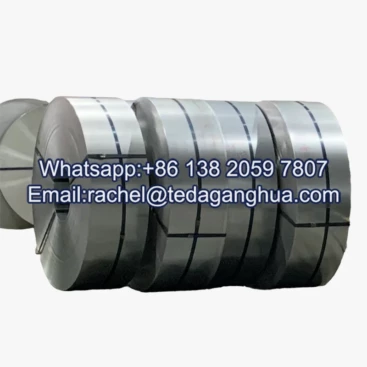
For aluminized flat products that will later be fabricated into tubes, Abgaskomponenten, Hitzeschilde, or other formed products, it is also useful to state the final application. This helps the supplier evaluate whether the selected coating class and substrate combination are compatible with the intended manufacturing process.


Teda Ganghua Commercial Support for Coated Steel Sourcing
Teda Ganghua supports specification-based sourcing for buyers who need aluminized steel products for forming, tube production, thermal applications, and other demanding industrial uses. Instead of selecting a coating class from the AS number alone, the inquiry can define substrate grade, Dicke, Abmessungen, Beschichtungsanforderung, forming condition, service temperature, Inspektionsunterlagen, and final application.
This approach helps procurement teams compare AS060 through AS150 on a technical basis and avoid paying for a coating level that is not required—or selecting a lower level that does not satisfy the project specification.
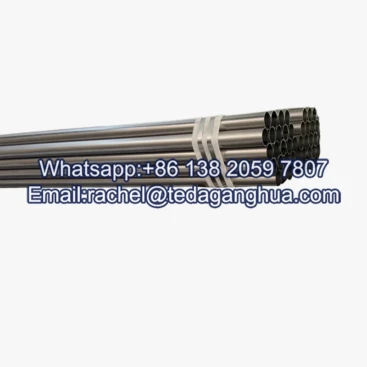
Aluminiumisierte Stahlrohre can be sourced according to application-specific dimensions, material requirements, surface condition, inspection needs, and production specifications.
Final Selection Checklist
- Define the applicable standard before selecting the coating class.
- Confirm whether AS060–AS150 is specified by coating mass and how it is tested.
- Assess corrosion exposure and expected service life.
- Assess continuous and cyclic temperature exposure separately.
- Check substrate grade and forming requirements.
- Consider coating adhesion after bending, drawing or tube forming.
- Compare the incremental coating cost against the actual functional benefit.
- Require MTC and coating inspection results for the agreed specification.
Häufig gestellte Fragen
Does AS150 always provide better performance than AS060?
A higher coating mass provides more coating material, but it does not automatically make the entire product more suitable for every application. Serviceumgebung, Temperatur, substrate, forming process and the governing specification must be considered together.
Does AS120 mean the steel can operate at 120°C?
NEIN. The AS number refers to a coating-mass class, not a temperature rating. Operating temperature must be evaluated from the complete material system and application conditions.
Is AS150 worth the additional cost?
That depends on the required service conditions and specification. If a lower coating class already satisfies the design requirement, additional coating may provide limited economic benefit. If the higher class is required for corrosion or service-life reasons, the additional cost may be justified as part of specification compliance.
Does a heavier coating improve deep-drawing performance?
Nicht unbedingt. Deep-drawing performance depends strongly on the steel substrate’s ductility, yield behavior, r-value, n-value, thickness and processing conditions. The coating must also maintain adequate adhesion during forming.
What information should I give a supplier when requesting AS-coated material?
Provide the substrate grade, geltenden Norm, Dicke, Abmessungen, coating class, Oberflächenanforderungen, forming process, Serviceumgebung, temperature range, Menge, inspection documents and final application. This gives the supplier enough information to evaluate the complete specification rather than quoting only an AS number.