Camada Intermetálica Fe-Al em Aço Aluminizado: Formação, Controle de Espessura & Qualidade
A camada intermetálica Fe-Al é a base de todo produto de aço aluminizado por imersão a quente de alta qualidade. While the visible aluminum coating provides corrosion resistance and heat reflectivity, the thin iron-aluminum (Fe-Al) diffusion layer underneath determines whether the coating remains firmly bonded throughout years of service. Proper control of this layer is one of the most critical aspects of aluminized steel manufacturing. If the intermetallic layer becomes too thin, coating adhesion may be insufficient. If it grows excessively thick, the coating becomes brittle and susceptible to cracking during forming or thermal cycling.
Understanding how the Fe-Al intermetallic layer forms, how its growth is controlled, and how it affects final product quality helps engineers and buyers evaluate the long-term reliability of aluminized steel tubes used in automotive, aquecimento industrial, power generation, e aplicações HVAC.
What Is the Fe-Al Intermetallic Layer?
During the hot-dip aluminizing process, steel is immersed in molten aluminum-silicon alloy. At temperatures around 680–720°C, iron atoms from the steel substrate diffuse into the molten aluminum while aluminum atoms simultaneously diffuse toward the steel surface.
This mutual diffusion creates a metallurgical transition zone composed of iron-aluminum intermetallic compounds rather than pure steel or pure aluminum.
| Coating Layer | Main Function |
|---|---|
| Outer Aluminum Layer | Corrosion resistance and heat reflection |
| Aluminum-Silicon Alloy Layer | Improves coating stability and surface quality |
| Fe-Al Intermetallic Layer | Creates metallurgical bonding between coating and steel |
| Steel Substrate | Provides structural strength |
How the Intermetallic Layer Forms
The formation process begins immediately after the steel enters the molten aluminum bath.
- Iron atoms migrate outward from the steel substrate.
- Aluminum atoms diffuse inward toward the steel.
- Iron and aluminum react to form stable intermetallic compounds.
- A continuous diffusion layer develops between the coating and the substrate.
Unlike adhesive bonding, this is a true metallurgical bond, making aluminized steel highly resistant to coating delamination.
Major Fe-Al Intermetallic Compounds
Several iron-aluminum compounds can form during hot-dip aluminizing. The most common include:
| Compound | Características |
|---|---|
| Fé2Al5 | Main diffusion layer with excellent bonding strength |
| FeAl3 | Forms near the aluminum coating and contributes to adhesion |
These compounds provide outstanding bonding strength but are naturally much harder and more brittle than either steel or aluminum.
Why Layer Thickness Matters
The Fe-Al layer should neither be excessively thin nor excessively thick.
| Layer Condition | Potential Result |
|---|---|
| Too Thin | Reduced coating adhesion |
| Optimized Thickness | Excellent bonding and good formability |
| Too Thick | High brittleness and increased cracking risk |
An optimized diffusion layer provides sufficient bonding while maintaining enough toughness for forming, soldagem, and long-term service.
Why Excessive Intermetallic Growth Is Harmful
If the Fe-Al compounds continue growing without control, several problems may occur:
- Coating cracks during bending.
- Reduced resistance to thermal cycling.
- Poor deep drawing performance.
- Higher probability of edge chipping.
- Reduced fatigue resistance.
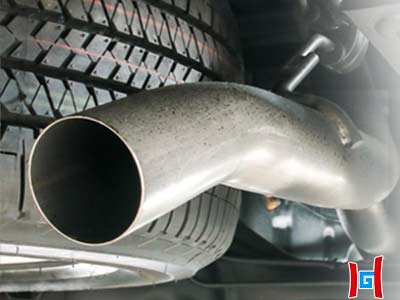
These defects are particularly critical for automotive exhaust tubing and formed industrial components that experience repeated deformation or vibration.
How Silicon Controls Intermetallic Growth
One of the most effective methods of controlling Fe-Al layer thickness is adding approximately 9–10% silicon to the molten aluminum bath.
Silicon modifies diffusion kinetics by:
- Reducing iron diffusion into molten aluminum.
- Slowing intermetallic growth.
- Refining crystal morphology.
- Producing a thinner and more uniform alloy layer.
Sem silício, intermetallic compounds grow much faster and become significantly thicker, resulting in brittle coatings.
Key Process Parameters That Influence Layer Growth
Several manufacturing variables directly affect the thickness and quality of the Fe-Al intermetallic layer.
| Process Parameter | Influence on Intermetallic Layer |
|---|---|
| Temperatura do banho | Higher temperatures accelerate diffusion |
| Immersion Time | Longer immersion increases layer thickness |
| Conteúdo de silício | Controls growth rate and crystal structure |
| Steel Chemistry | Carbon and alloying elements influence diffusion behavior |
| Preparação de Superfície | Clean surfaces produce more uniform bonding |
Quality Inspection of the Fe-Al Layer
Manufacturers typically verify coating quality using metallurgical inspection rather than visual appearance alone.
Common evaluation methods include:
- Metallographic cross-section analysis.
- Optical microscopy.
- Scanning electron microscopy (Qual).
- Medição da espessura do revestimento.
- Bend testing.
- Adhesion testing.
These inspections confirm that the diffusion layer remains continuous, uniforme, and free from excessive brittle growth.
Typical Defects Caused by Poor Layer Control
| Defect | Possible Cause |
|---|---|
| Coating cracking | Excessively thick intermetallic layer |
| Poor adhesion | Incomplete diffusion layer formation |
| Surface roughness | Unstable alloy growth |
| Edge chipping | High brittleness of Fe-Al compounds |
| Forming cracks | Insufficient ductility of the coating |
Why Proper Control Improves Service Life
A properly controlled Fe-Al layer allows aluminized steel products to maintain coating integrity throughout demanding operating conditions.
Benefits include:
- Improved resistance to thermal expansion.
- Reduced coating delamination.
- Higher fatigue durability.
- Better resistance to repeated forming operations.
- Longer corrosion protection.


Applications That Depend on Stable Intermetallic Layers
- Sistemas de exaustão automotivos
- Tubos de forno industrial
- Boiler components
- Trocadores de calor
- HVAC ventilation ducts
- Equipamento de secagem agrícola
- Industrial chimneys
Teda Ganghua Aluminized Steel Tube Manufacturing
Teda Ganghua applies strict process control throughout the hot-dip aluminizing process to optimize Fe-Al intermetallic layer formation. By carefully managing bath chemistry, immersion conditions, and coating parameters, Teda Ganghua produces aluminized steel tubes with excellent coating adhesion, controlled diffusion layers, and reliable long-term performance for automotive, aquecimento industrial, Hvac, and high-temperature processing applications.
From raw material selection to final quality inspection, every production stage is designed to achieve stable metallurgical bonding while minimizing brittle intermetallic growth.
Learn more about our
tubos de aço aluminizados
for demanding industrial applications.
Perguntas frequentes
What is the purpose of the Fe-Al intermetallic layer?
It creates a metallurgical bond between the aluminum coating and the steel substrate, ensuring excellent coating adhesion and long-term durability.
Why is a thick intermetallic layer undesirable?
Excessive growth increases brittleness, making the coating more likely to crack during bending, formando, or thermal cycling.
How does silicon help control the Fe-Al layer?
O silício retarda a reação de difusão entre ferro e alumínio, produzindo um mais fino, mais uniforme, e camada intermetálica menos frágil.
A camada Fe-Al pode ser inspecionada?
Sim. Metallographic cross-section analysis, microscopia, testes de adesão, e testes de dobra são comumente usados para avaliar sua qualidade.
Por que a camada Fe-Al é importante para tubos de aço aluminizado?
Determina a adesão do revestimento, formando desempenho, resistência ao calor, e a confiabilidade a longo prazo do tubo acabado em ambientes industriais exigentes.